

Improve Self Esteem: Practical Ways to Build Confidence and Self-Worth | Step-by-Step
How to Improve Self Esteem Step by Step Guide

Content
Nobody wakes up one morning and decides to think poorly of themselves. It accumulates — through years of criticism absorbed, comparisons made, boundaries never set, and achievements quietly dismissed. By the time you recognize the pattern, it feels less like a problem and more like a personality trait. Just who you are.
But it isn't who you are. It's a habit of perception — reinforced through repetition, shaped by circumstance, and entirely capable of shifting once you start feeding it different inputs.
This guide isn't about manufacturing fake positivity or memorizing affirmations that feel hollow. It's about concrete, evidence-backed steps that gradually rebuild the relationship you have with yourself. Small actions. Repeated consistently. Producing real change over time — not overnight, but genuinely.
Whether you're navigating this independently or considering professional support, what follows gives you a working framework to start today.
What It Means to Improve Self Esteem
Self worth improvement isn't about reaching a state of permanent confidence where doubt never visits. That's not realistic for anyone. Building self esteem means developing a stable, fundamentally respectful relationship with yourself — one where setbacks don't shatter your entire sense of identity, where your value isn't contingent on output, and where you can acknowledge both strengths and limitations without collapsing into shame.
Think of it as an internal baseline. People with functional self-regard still experience disappointment, insecurity, and failure. The difference lies in how those experiences get processed. A difficult week doesn't become proof of permanent inadequacy. A mistake stays a mistake — it doesn't metastasize into "I am a mistake."
Self-Esteem vs Self-Confidence
These terms get used interchangeably, but they operate differently. Self-esteem concerns your fundamental sense of worth as a person — the deep-down belief about whether you matter. Self-confidence relates to your trust in specific abilities — whether you believe you can perform a particular task or navigate a particular situation.
Understanding how to build self confidence matters because the two reinforce each other. Demonstrating competence in specific areas feeds your broader sense of worth. And a stable foundation of self-respect makes you more willing to attempt things you're uncertain about — which builds confidence through experience.
You can have high confidence in your professional skills while harboring very low esteem about your value as a human being. Addressing one without the other leaves the picture incomplete.

Author: Benjamin Carter;
Source: ameliaearhartbook.net
Why Self-Esteem Drops in Adulthood
Most conversations about self-worth focus on childhood origins — and those matter enormously. But plenty of people enter adulthood with reasonable self-regard, only to watch it erode under pressures that accumulate gradually.
Career stagnation or job loss can dismantle professional identity. Relationship patterns involving criticism, control, or emotional withdrawal chip away at your sense of deserving better. Chronic stress and burnout deplete the internal resources needed to maintain perspective. Social media delivers an unbroken stream of curated lives against which your unfiltered reality consistently falls short.
The erosion rarely happens dramatically. More commonly, it's incremental — each small blow absorbed without recovery time until your baseline shifts downward and you forget it was ever higher.
Recognizing that low self esteem help doesn't require tracing everything back to age five matters here. Present-day factors create and sustain the problem, and present-day interventions can address it directly.
The Role of Relationships and Support
Your social environment functions as a mirror — and the reflection you receive shapes self-perception more powerfully than most people realize. Relationships built on mutual respect, honest feedback, and genuine encouragement create conditions where gaining confidence happens organically. Relationships characterized by dismissal, competition, or emotional manipulation do the opposite.
This doesn't mean surrounding yourself exclusively with people who agree with everything you say. It means gravitating toward connections where honesty comes wrapped in care — where someone can tell you the truth without making you feel diminished for hearing it.
How to Improve Self Esteem Step by Step
This section forms the operational core. Each step builds on the previous one, though you can enter at whichever point feels most relevant.
Spot and Reframe Negative Self-Talk (CBT-Style)
The internal narrator running your self-assessment operates largely on autopilot. You don't consciously choose to think "I'm not good enough" — the thought fires automatically, feels true, and gets accepted without examination.
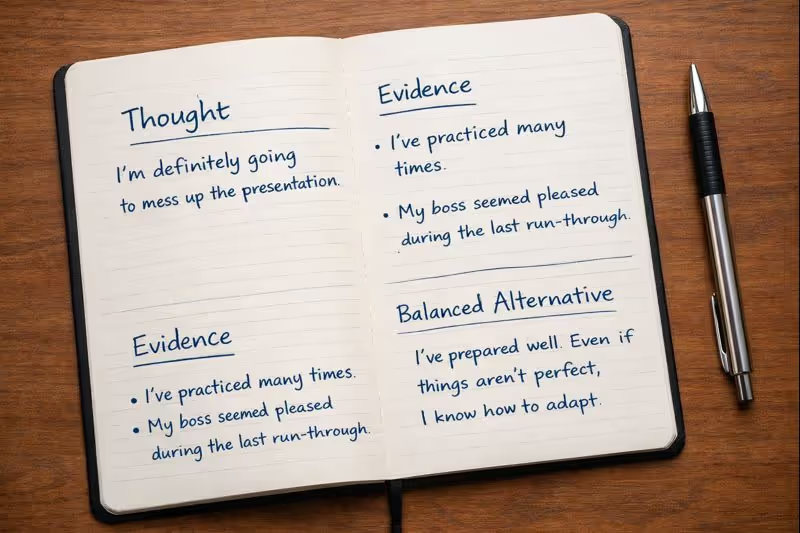
Cognitive behavioral methods teach you to interrupt this cycle. The framework is straightforward:
- Catch the thought. Notice when a harsh self-evaluation surfaces. ("I completely embarrassed myself in that meeting.")
- Examine the evidence. What concrete facts support this interpretation? What facts contradict it? Did anyone actually react negatively, or are you assuming?
- Generate a balanced alternative. ("I stumbled over one point, but I communicated the rest clearly. One imperfect moment doesn't define the entire presentation.")
This isn't about replacing negative thoughts with artificially positive ones. It's about replacing distorted thoughts with accurate ones. When you improve self esteem naturally through habitual thought examination, the shift sustains itself because it's grounded in reality rather than wishful thinking.
Author: Benjamin Carter;
Source: ameliaearhartbook.net
Set Tiny Goals and Keep Promises to Yourself
Every unfulfilled self-promise erodes internal trust. Every kept one rebuilds it. The scale of the promise matters far less than the follow-through.
Start absurdly small. Commit to one five-minute walk. Send one email you've been avoiding. Spend ten minutes on a project that intimidates you. The point isn't productivity — it's demonstrating to yourself that your word to yourself means something.
Track these completions. Written evidence of consistency counters the narrative that you never follow through. Over weeks, the accumulated record speaks louder than the inner critic.
This is how to boost self esteem without grand gestures — through quiet, repeated proof that you can trust your own commitments.

Author: Benjamin Carter;
Source: ameliaearhartbook.net
Build Self-Confidence Through Exposure and Skill Reps
Confidence is generated by action, not by waiting until you feel ready. Every instance of doing something despite uncertainty deposits evidence into your self-trust account.
Practical starting points: voice one opinion during a group discussion. Ask for help with something you've been struggling with silently. Sign up for a class in an area that interests you but where you hold no expertise. Accept an invitation you'd normally decline.
Understanding how to improve self confidence and how to gain confidence comes down to this principle: competence follows participation. You don't need to perform flawlessly — you need to participate repeatedly. The skill develops through reps, and the confidence follows the skill.
Strengthen Boundaries and Reduce Comparison
Boundaries protect your internal resources the way a fence protects a garden. Without them, external demands consume everything you're trying to cultivate.
Practical self esteem tips for adults include: practice declining one non-essential request per week. Identify the social media accounts that consistently trigger comparison spirals and mute or unfollow them. Notice when you're about to say "yes" out of guilt rather than genuine willingness — and pause before responding.
Digital hygiene deserves specific attention. Curate your feeds intentionally. The goal isn't total withdrawal from online life but conscious selection of inputs that support rather than undermine your developing self-regard.
Support Your Body (Sleep, Movement, Nutrition)
This isn't positioned as a cure — it's positioned as a foundation. Chronic sleep deprivation impairs emotional regulation. Sedentary routines correlate with lower mood. Poor nutritional patterns affect brain chemistry directly.
None of these physical foundations replace psychological work, but they create conditions under which psychological work produces better results. Prioritize sleep consistency over duration optimization. Choose movement you actually enjoy over punishing exercise routines. Eat in ways that sustain energy rather than following restrictive protocols that add another source of failure.
The body and mind operate as a single system. Supporting one reinforces the other.
Self Esteem Without Therapy
Professional guidance produces excellent outcomes — but not everyone has access, readiness, or desire for formal therapy at this moment. A substantial amount of meaningful progress is achievable independently through structured daily practice.
A Simple 14-Day Routine (10–15 Minutes/Day)
Here is a list of some things that you can do to help improve your own self-esteem — organized as a repeatable daily framework:
- Morning (5 minutes): Write down one specific thing you handled well yesterday. Not a vague positive thought — a concrete action or decision you made that went reasonably.
- Midday (2 minutes): When you catch one instance of harsh self-talk, run it through the CBT reframe: thought → evidence → balanced alternative. Just one.
- Evening (5 minutes): Record one small commitment you kept today. Additionally, identify one moment where you connected genuinely with another person — a real conversation, a kind exchange, a moment of honesty.
- Weekly addition: Each Sunday, attempt one "micro-courage" action for the upcoming week — something slightly outside your comfort zone. Speaking up, setting a boundary, trying something unfamiliar, reaching out to someone.
Fourteen days of this routine won't transform your entire self-concept. But it establishes a practice infrastructure that, maintained over months, produces compounding results.
Author: Benjamin Carter;
Source: ameliaearhartbook.net
When Self-Help Isn't Enough
Independent work has genuine limits. Consider professional support if:
- Low self-regard has persisted for years without meaningful fluctuation despite personal effort
- Depression, anxiety, or trauma responses are entangled with the self-worth pattern
- Relationship dynamics or life functioning are significantly impaired
- The internal narrative feels so fixed that no alternative perspective feels accessible
Seeking clinical help isn't an admission of failure — it's a resource allocation decision. Some patterns require tools that self-directed work alone cannot provide.
Quick Table
Unhelpful Thought → Balanced Thought → One Helpful Action
| Unhelpful Thought | Balanced Thought | One Helpful Action |
| "I'm going to embarrass myself" | "I might feel awkward, but I've managed similar situations before" | Attend the event; stay for 30 minutes minimum |
| "I don't deserve this opportunity" | "I meet the qualifications; my doubts aren't disqualifying facts" | Submit the application today |
| "Nobody actually enjoys my company" | "Several people consistently choose to spend time with me" | Accept one social invitation this week |
| "I'll never be good enough" | "Enough for what? I'm adequate for many things and learning others" | List three tasks completed successfully this month |
Self-Esteem vs Confidence vs Self-Worth
| Dimension | Self-Esteem | Self-Confidence | Self-Worth |
| Core question | "Am I a valuable person?" | "Can I do this specific thing?" | "Do I deserve good things?" |
| Scope | Global self-evaluation | Task or domain-specific | Fundamental sense of deserving |
| Built through | Self-compassion, belief restructuring | Practice, repetition, exposure | Boundary-setting, values alignment |
Real-Life Examples (Short)
Work — from avoidance to micro-step: Jenna has avoided applying for senior roles for two years. Instead of targeting the director position immediately, she commits to one action: updating her resume this weekend. The following week, she sends it to one trusted colleague for feedback. Momentum builds from a single, manageable step — not from waiting until confidence arrives.
Relationships — from people-pleasing to one boundary script: David reflexively agrees to every request from his family, then quietly resents the overload. He prepares one sentence: "I'd like to help, but I can't take that on right now." He uses it once. The world doesn't collapse. He uses it again the following week. Each instance reinforces that his needs hold legitimate weight.
Social — from avoidance to graded exposure: Priya hasn't attended a social gathering in months. Rather than committing to a full evening out, she agrees to meet one friend for coffee — thirty minutes, a familiar location. The next week, she extends to forty-five minutes. The week after, a different location. Each increment expands her tolerance without overwhelming her system.
Expert Insights
Low self-esteem can be improved through strategies that are commonly used in cognitive behavioral therapy and professional counseling — including identifying negative thought patterns, challenging their accuracy, and replacing them with more realistic perspectives.
— Mayo Clinic Staff
This aligns directly with the step-by-step framework outlined above. The clinical evidence supports what practical experience confirms: examining your thoughts rather than obeying them is the single most impactful habit for shifting self-perception.
Practical steps such as being kind to yourself, recognizing your positives, building a supportive network, and setting yourself challenges all contribute to improved self-esteem over time.
— Mind, UK Mental Health Charity
What stands out here is the breadth — no single intervention does all the work. Improvement emerges from multiple channels operating simultaneously: internal dialogue, social connections, behavioral challenges, and self-compassion. The most sustainable progress comes from addressing several of these channels in parallel rather than relying on any one alone.
Frequently Asked Questions
Rebuilding your relationship with yourself doesn't require dramatic intervention or radical personality change. It requires showing up — consistently, imperfectly, and with more patience than you probably think you deserve.
One reframed thought. One kept promise. One boundary honored. One moment where you choose curiosity over avoidance. These individual actions feel insignificant in isolation, but they compound. Week by week, the internal evidence mounts: you are someone who follows through, who can handle discomfort, who deserves the same respect you extend to others.
The voice that insists otherwise has been rehearsing its script for years. It won't go silent overnight. But it will gradually lose authority as you steadily replace its claims with lived proof to the contrary.
Start small. Stay consistent. Treat yourself with the same basic decency you'd offer anyone you care about. The rest builds from there.