

The silence after a "no" often weighs more
How to Handle Rejection in a Healthy Way

Content
Three rounds of interviews — then silence. A goodnight kiss — then ghosting. Being turned down lands with a weight that logic can't lift. But the ache isn't proof something is broken. It's a nervous system responding to a threat it was trained across millennia to take seriously.
What Is Rejection — and Why Does It Sting So Deeply?
Types of Rejection We All Face
Social rejection covers four main domains. Romantic: a partner walks away or connection dissolves into silence. Career: the application that disappeared, the promotion given to someone else. Social: the party you weren't invited to, the friendship that stopped being mutual. Family: coldness from people who were supposed to love you unconditionally. Different nerves, same core fear. The feelings of rejection hit hardest when they confirm a suspicion you already carry: maybe I don't belong.
The Neuroscience Behind the Pain of Rejection
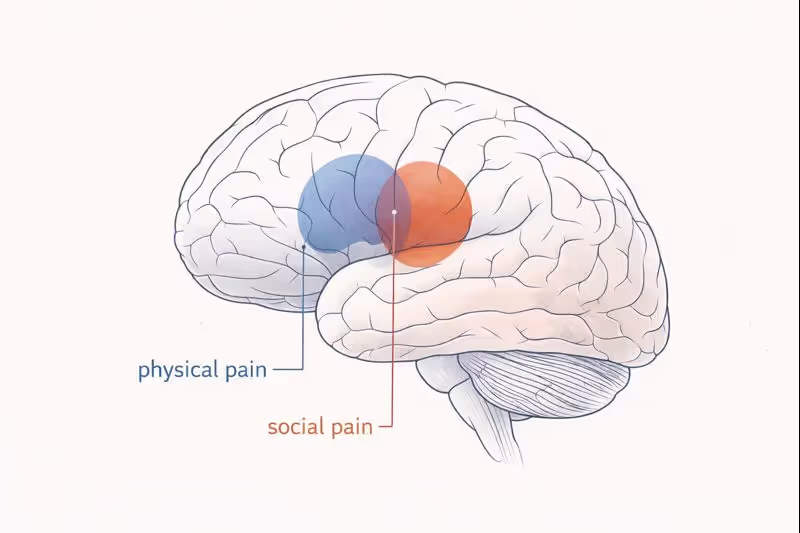
Brain imaging shows social exclusion activates regions overlapping with those triggered by physical injury — particularly the dorsal anterior cingulate cortex, the same area that lights up when you burn your hand. Your brain doesn't separate a sprained wrist from a shattered expectation. Evolutionarily this makes sense: separation from the tribe meant predators, starvation, and near-certain death. That alarm system still fires today, which is why "we went with another candidate" can feel like the floor dropping out. One well-known experiment demonstrated that even a simulated ball-tossing game where participants were excluded produced measurable distress responses within minutes.
Author: Benjamin Carter;
Source: ameliaearhartbook.net
How Rejection Affects Your Mental Health
The Emotional Spiral — From Self-Doubt to Avoidance
Unaddressed pain follows a slope: acute sadness and disbelief → "What's wrong with me?" → anticipatory dread → full withdrawal. People stop applying, stop reaching out, stop risking another "no." The real damage isn't the initial setback — it's unprocessed hurt shrinking your world until avoidance feels like the only safe option. Dealing with rejection early prevents this contraction.
Cognitive Traps That Make It Worse

Author: Benjamin Carter;
Source: ameliaearhartbook.net
- Making it personal — "They passed because I'm not good enough." You absorb total responsibility for an outcome shaped by invisible variables.
- Binary thinking — "Didn't work here, won't work anywhere." One data point becomes universal law.
- Pattern invention — "This always happens to me." One experience rewrites itself as an inescapable trend.
- Imagining verdicts — "Everyone thinks I'm pathetic." You author others' opinions and react as if they're confirmed.
Naming these traps creates a gap between thought and reaction. That gap is where better choices live.
How to Deal with Rejection — Practical Strategies That Work
People searching for how to cope with rejection usually want two things: immediate relief and a plan that holds up long-term. The strategies below cover both. Coping with rejection becomes manageable once you stop treating a "no" as a verdict and start treating it as data.
Allow Yourself to Feel Without Drowning in It
Don't outrun the feeling — buried hurt resurfaces as irritability, exhaustion, or tears over nothing. Give yourself a set window: an evening, a walk. Let disappointment exist. But set a border — grief without a time limit becomes obsessive replay that pins you in place.
Separate Your Self-Worth from the Outcome
The most protective skill you can build: a clean boundary between what happened and who you are. A lost position doesn't erase competence. A partner leaving doesn't cancel your capacity to be loved. Being turned down is almost always about fit or timing — not a verdict on your value. Protecting self-worth after rejection means repeating that until the nervous system catches up with what the rational mind already knows.
The distress you feel after being turned down travels through the same neural corridors as physical injury. It isn't imagined, it isn't theatrical, and it isn't weakness — it is biology demanding your attention.
— Guy Winch
Reframe the Setback as a Pivot
Not forced optimism — pattern recognition. Review your own history: some of your best turns likely followed a closed door. The collapsed relationship made room for a better one. The dead-end career path redirected you to work you enjoy. Reframing adds a second lens: "Painful now — possibly steering me somewhere I wouldn't have gone voluntarily."
Lean on Your Support System
Isolation amplifies the "I don't belong" story. Connection dismantles it. Reach out to someone you trust — not to spiral, but to hear a perspective the setback temporarily blocked. Coping with a difficult "no" is markedly easier when you let people in.
Use Journaling to Break the Replay Loop
Write bare facts, then write what you've decided those facts mean about you. The canyon between "she didn't reply" and "she thinks I have nothing to offer" becomes visible on paper — and harder to treat as truth.
| Grounded Response | Self-Defeating Response |
| Acknowledges the hurt without burying it | Numbs with substances, overwork, or avoidance |
| Keeps personal value separate from the outcome | Treats being turned down as proof of inadequacy |
| Reaches out for perspective | Withdraws from all contact |
| Asks "what can I take from this?" | Replays obsessively without insight |
| Sharpens the next attempt | Avoids all future risk |
| One event, not a life verdict | "I'll always end up on the outside" |
Rebuilding Confidence After Rejection
The link between rejection, confidence, and self-image runs deep — each unanswered application or ended relationship chips away at how capable you feel. Restoring that belief requires deliberate internal work, not just time.

Author: Benjamin Carter;
Source: ameliaearhartbook.net
Practice Self-Compassion — Not Self-Punishment
The inner voice after a setback is usually merciless: "You should have known. Of course they said no." That critic deepens the wound, not shields from it. Replace it with what you'd tell a friend: "That was rough. You put yourself out there. You deserve kindness, not a lecture." Research links self-compassion with faster recovery; habitual self-criticism predicts retreat.
Genuine belonging never asks you to become someone else — it asks you to show up as yourself. When your sense of worth is rooted inside rather than in other people's reactions, a 'no' still stings, but it stops threatening the foundation of who you are.
— Berne Brown
Affirm What You Bring to the Table
Author: Benjamin Carter;
Source: ameliaearhartbook.net
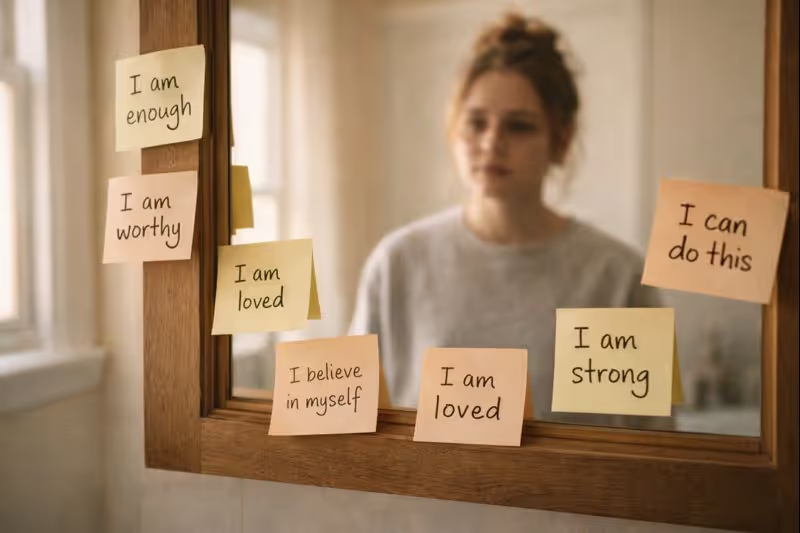
Write down five real strengths — to restore a picture one outcome temporarily warped. If your view is clouded, ask a friend what they value about you. Rebuilding confidence means refusing to let one person's decision overwrite years of evidence.
Mental Toughness Exercises to Build Lasting Resilience
Recovering from one "no" is one thing. Building psychological resilience that absorbs repeated setbacks is another. True emotional resilience — the kind that holds up when rejection hits repeatedly — doesn't appear on its own. It's trained. These exercises build that capacity so you bend instead of breaking.
Deliberate Discomfort Training
Mental fortitude builds through measured resistance. Cold water at the end of a shower. A plank held past the trembling point. Phone untouched for the first hour. Each signals to your brain: "Discomfort is survivable." That signal compounds and transfers to emotional situations.
Rejection Exposure Practice
Seek small "no's" on purpose: request an upgrade at a hotel, ask for a discount at a café, start a conversation with a stranger. The goal isn't winning — it's experiencing refusal safely and walking away intact. One approach: set a target of one intentional ask per day for 30 days. By week two, most people report the dread fading noticeably. Your system accumulates firsthand data: a "no" is uncomfortable but not dangerous — and that data rewrites the fear response at a level deeper than willpower alone.
Mindfulness and Emotional Labeling

Author: Benjamin Carter;
Source: ameliaearhartbook.net
Emotions after a blow arrive tangled. Pause and name each thread: "That's shame. That's fear of being alone. That's anger at myself for hoping." Research shows labeling dials down intensity by engaging the prefrontal cortex and quieting the amygdala. A practical method: set a two-minute timer, close your eyes, and scan what you're feeling from the chest upward. Assign one word to each sensation. It shifts "I'm drowning" to "I see the wave, and I can ride it." Even five days of this practice shows measurable gains in emotional regulation. Long-term, this is how emotional resilience after rejection actually develops — not by avoiding feelings, but by meeting them with precision.
When to Seek Professional Help
If the ache hasn't loosened after several weeks, if you're withdrawing from things that mattered, if sleep or appetite has shifted, or if one setback cracked open an older wound — a therapist is a solid next step. Cognitive behavioral therapy (CBT) targets the exact thinking patterns that keep people stuck; acceptance and commitment therapy (ACT) builds flexibility around painful emotions rather than fighting them. Even 6–8 sessions focused specifically on setback processing can produce lasting shifts. Seeking help isn't fragility — it's treating your psychological stamina with the same seriousness as a physical injury.
Frequently Asked Questions