
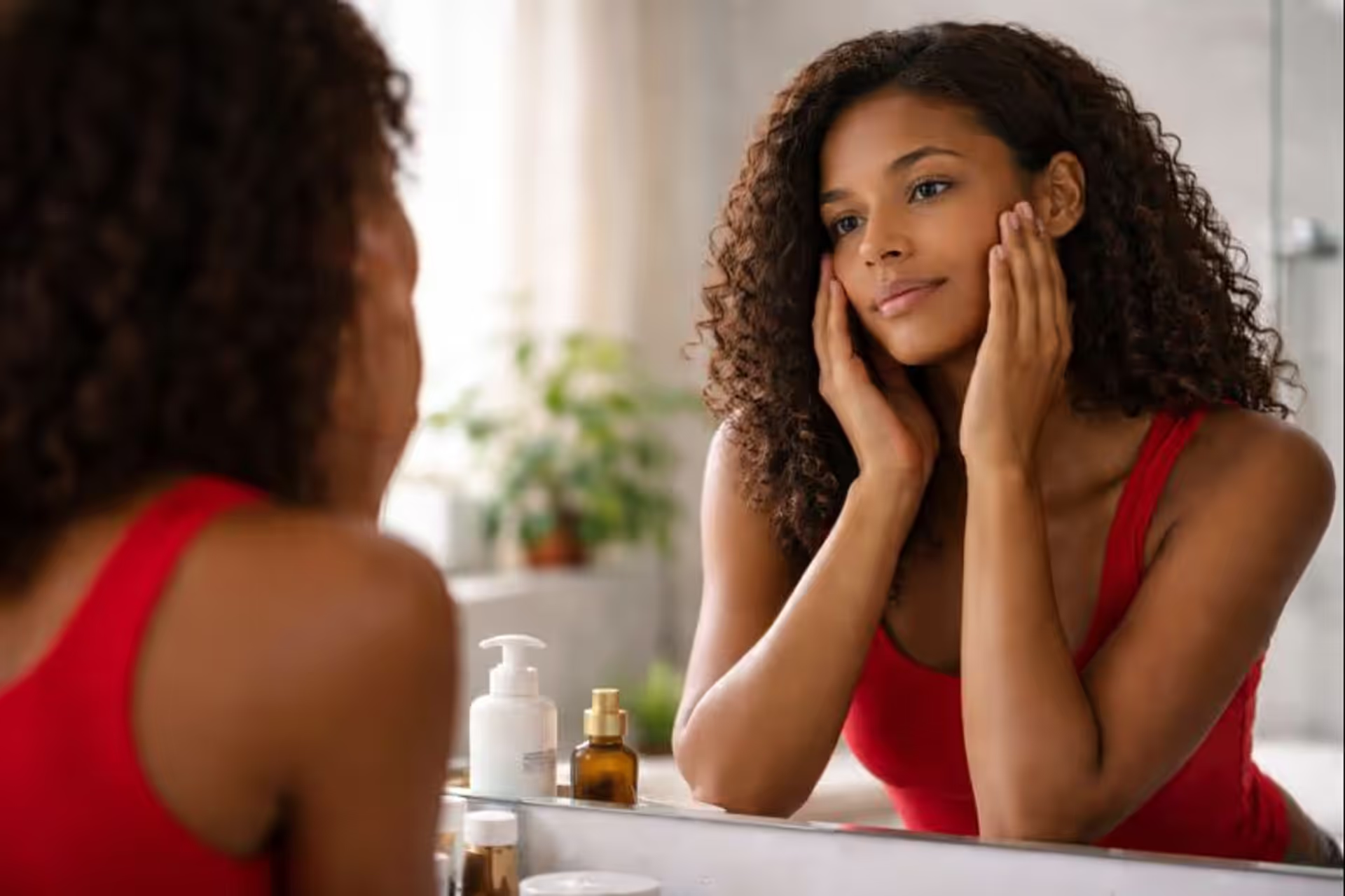
The inner picture of your body rarely matches what others actually see
What Is Body Image and Why It Matters for Self Image

Content
Most of us have a running inner commentary about the way we look — and for a surprising number of people, that commentary isn't kind. An offhand glance in a dressing-room mirror can ruin an afternoon. A candid photo at a gathering can spiral into days of self-criticism. These reactions are so ordinary that we rarely ask a deeper question: where do they come from, and why do they hold so much power?
Below, we'll explore the real meaning behind body image, the forces that warp it, the toll it takes on emotional wellbeing, and — most importantly — concrete ways to shift the internal narrative toward something more livable.
What Is Body Image?
Body Image Definition and Meaning
In everyday language, body image describes the internal picture you carry of your physical self. That picture isn't neutral — it arrives loaded with judgments, memories, and emotional charge. Two people with identical measurements can hold wildly different opinions of how they look, because the mental snapshot is shaped less by reality and more by the lens a person has learned to view their reflection through.
Worth noting: the concept isn't limited to weight. Feelings about skin texture, height, facial structure, scars, hair, and visible differences of all kinds feed into the same internal evaluation. Anything the mind decides to measure against an imagined standard can become part of the equation.
Author: Lauren Whitestone;
Source: ameliaearhartbook.net
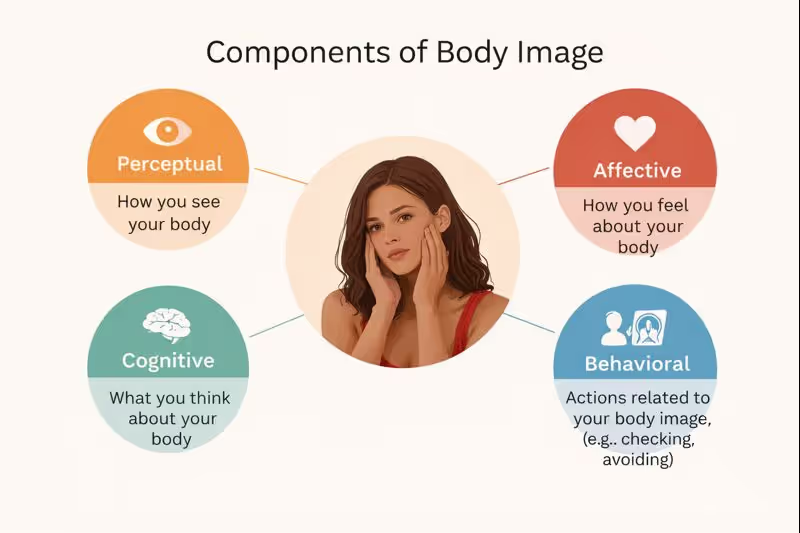
The Four Components of Body Image
Researchers usually describe four interlocking dimensions:
- Perceptual — the way you literally see yourself in a mirror or mind's eye, which can differ significantly from what others observe.
- Affective — the emotional tone you attach to your looks: contentment, indifference, anxiety, shame.
- Cognitive — the specific thoughts looping through your head ("My arms are too big," "At least I have good hair").
- Behavioral — the decisions that follow: choosing concealing clothes, dodging cameras, skipping meals, or spending hours at the gym out of obligation rather than enjoyment.
When one dimension is off balance, the ripple reaches the others fast — which is why surface-level fixes rarely resolve the discomfort underneath.
Positive vs. Negative Body Image
What Does a Healthy Relationship with Your Body Look Like?
Having a healthier perception of your body doesn't require morning affirmations in front of the mirror. It means you can acknowledge your physical self without letting that acknowledgment dictate your mood or your plans. People who feel at ease in their skin tend to eat according to internal cues, choose movement they enjoy, and recover more quickly when outside messages threaten their equilibrium.
Warning Signs That Something Is Off

Author: Lauren Whitestone;
Source: ameliaearhartbook.net
A fleeting moment of "I wish I looked different" is human. A relentless cycle of appearance-focused anxiety is something else entirely. Red flags include:
- Harsh internal dialogue about specific features that plays on a loop.
- Turning down invitations — the pool party, the work event, the date — to avoid being seen.
- Rituals around mirrors: either checking obsessively or refusing to look at all.
- Letting the number on a scale set the emotional tone for the entire day.
- Measuring yourself against every edited photo that scrolls past on your phone.
- A nagging sense in public spaces that everyone is silently evaluating your looks.
- Treating food restriction or punishing workouts as tools to "earn" self-acceptance.
| Grounded Self-Perception | Distorted Self-Perception |
| Can live with imperfections without fixating | Zooms in on flaws until they dominate the view |
| Feels at home in own skin most days | Feels shame, dread, or disgust about appearance |
| Values the body for what it can do | Reduces the body to how it looks |
| Sense of worth anchored in character and actions | Sense of worth chained to physical appearance |
| Eats and moves in a balanced, flexible way | Swings between rigid restriction and loss of control |
| Engages with media without absorbing its ideals | Internalizes every curated image as a personal benchmark |
What Causes Body Image Issues?
No single event flips the switch. Trouble with how you see yourself usually develops through an accumulation of pressures — some loud, some barely perceptible — that together reshape the internal lens over months and years.

Author: Lauren Whitestone;
Source: ameliaearhartbook.net
Social Media and Manufactured Beauty Ideals
Platforms reward content that grabs attention, and nothing stops a thumb mid-scroll like a flawless face or sculpted physique. The catch: most of those images have been retouched, posed under studio lighting, or surgically enhanced before anyone hits "post." A peer-reviewed study from 2023 showed that participants who cut daily screen time by just thirty minutes reported a noticeable shift in self-perception within weeks. The implication: the more curated content you consume, the more warped your personal benchmark becomes.
For many people, how they perceive their body isn't just one facet of who they are — it becomes the lens through which they judge their entire worth. That's not vanity. It's the product of powerful psychological and cultural conditioning.
— Melissa Gerson
Messages Absorbed in Childhood
Long before a teenager downloads their first social app, they've absorbed thousands of cues about which bodies are "right." A mother who apologizes for eating dessert. A father who praises thinness. Classmates who assign cruel nicknames based on weight. These early signals get woven so deeply into a young person's wiring that, by adulthood, the resulting beliefs feel less like opinions and more like facts.
Weight Stigma and the Dieting Trap
Modern wellness culture often disguises prejudice as health advice. Equating thinness with discipline and larger bodies with laziness creates a climate where people pursue shrinking themselves out of shame, not medical need. That pursuit — the chronic yo-yo of restriction and rebound — is linked to worsening dissatisfaction and a growing sense of failure each time the scale drifts back.
The Comparison Reflex
Some degree of social comparison is hardwired — it helps humans calibrate within a group. But when the habit goes unchecked, it morphs into a constant measuring contest where you always come up short. That chronic measuring fuels appearance-related anxiety: a persistent dread of being scrutinized that can make ordinary activities — attending a meeting, walking into a gym — feel exposing.
Body Image and Mental Health
The relationship between how you see your body and how you feel overall isn't casual — it's structural. Ongoing dissatisfaction functions as a slow-burning stressor that can initiate or intensify a range of psychological difficulties.
The Self-Esteem Connection
Researchers have estimated that roughly a quarter of a person's overall self-regard is tied to physical self-perception. When "how I look" and "who I am" become knotted together, a single unkind comment can feel like a verdict on your entire character. This fusion sits at the root of many confidence struggles.
When negative evaluations of one's own appearance take center stage, the fallout extends well beyond the mirror. They tend to predict wider emotional distress across multiple areas of life.
— Thomas F. Cash
Mood Disorders and Disordered Eating
Population-level data consistently reveals that about one in three adults has felt anxious or low specifically because of how they perceive their own body. In more severe cases, roughly one in eight reports having had thoughts of self-harm linked to the same concerns.
Chronic dissatisfaction with appearance is also recognized as one of the most reliable predictors of eating pathology — from anorexia and bulimia to binge-eating patterns. The mechanism is circular: a distorted view drives harmful behaviors, and those behaviors deepen the distortion.
Body Dysmorphic Disorder
Sometimes the gap between perceived and actual appearance widens into something clinical. Body dysmorphic disorder (BDD) involves an overwhelming preoccupation with features that are either minor or entirely imagined by outside observers. It affects one to three percent of the population and can produce hours of mirror-checking, avoidance of social contact, and repeated cosmetic procedures. Effective treatment usually involves cognitive behavioral therapy, sometimes combined with medication.
Key Statistics Worth Knowing
- Close to eight in ten American women say they've struggled with how they view their bodies at some point in life.
- Among men, measurable dissatisfaction with appearance affects an estimated ten to thirty percent.
- More than half of girls in the U.S. express unhappiness with their looks by age thirteen; nearly eight in ten do so by seventeen.
- Between 2009 and 2015, appearance-related distress among young adults aged sixteen to twenty-five increased by roughly a third.
Practical Ways to Rebuild Your Relationship with Your Body
The shift isn't about forcing yourself to love the mirror. It's about loosening the grip that the mirror has on your sense of self.
Interrupt the Inner Critic
Next time a thought like "I look terrible" surfaces, try a test: would you say this to someone you care about? If not, it doesn't deserve a seat at your internal table. Swap the judgment for something factual — "These legs carried me up four flights today" — and practice until the neutral voice gets louder than the harsh one.
Curate Your Digital Environment
Your feed is not a window onto reality — it's a highlight reel engineered for engagement. Remove accounts that consistently leave you feeling worse. Seek out creators who present unfiltered, diverse bodies. Consider hard time limits: less scrolling consistently correlates with a healthier self-view.
Anchor Your Identity Beyond the Mirror
When your entire sense of worth depends on how you look, every unflattering moment becomes a crisis. The counterweight is deliberate investment in dimensions unrelated to appearance — humor, skills, relationships, values. A richer identity is a more resilient one.
Explore Body Neutrality
The "love your body" message sounds empowering, but for many it sets an impossible bar. A more sustainable alternative is neutrality: you don't have to celebrate your body on a tough day — just stop weaponizing your feelings against it. The shift from "How do I look?" to "What am I able to do today?" is often where genuine relief begins.

Author: Lauren Whitestone;
Source: ameliaearhartbook.net
Move Because It Feels Good
Activity done as penance for eating reinforces the very dissatisfaction you're trying to escape. Movement chosen because it brings pleasure — a bike ride, a dance class, an evening walk — rebuilds trust between you and your body.
When to Seek Professional Help
If preoccupation with your looks is interfering with meals, relationships, or work, a trained therapist can untangle patterns that willpower alone can't shift. Cognitive behavioral approaches have the strongest evidence base. Somatic and trauma-focused methods — including EMDR — can reach layers that conversation sometimes misses.
Frequently Asked Questions