

Seeking Validation: What It Means, Why We Crave Approval & How to Stop | Practical Guide
What Is Seeking Validation and Why It Happens

Content
There's a particular kind of exhaustion that comes from outsourcing your sense of okay-ness. Not physical fatigue — something subtler. The constant background hum of monitoring how people react to you, scanning faces for approval, replaying conversations to determine whether you said the right thing.
Most people recognize this pattern in hindsight rather than in real time. It doesn't announce itself as a problem. It feels like caring, like conscientiousness, like being a good partner or colleague or friend. The cost only becomes visible once you notice how little of your self-assessment originates from within — and how much depends on the latest signal from someone else.
This article unpacks seeking validation from multiple angles: what drives it, where the line sits between normal social need and compulsive approval-chasing, and concrete steps for building a version of self-worth that doesn't collapse every time external feedback shifts.
External Validation Explained
Before addressing solutions, the mechanics deserve clear framing. The term gets used loosely, so precision matters.
What Does "Seeking Validation" Mean?
Seeking validation describes the behavioral pattern of relying on external signals — praise, agreement, reassurance, attention — to determine your own worth or the correctness of your decisions. In its milder forms, this is entirely normal. Humans are social organisms; caring about how others perceive you served survival purposes for millennia.
The pattern becomes problematic when approval functions as the primary regulator of your emotional state. When a compliment from your manager determines whether you have a good day. When your partner's tone of voice dictates whether you feel secure. When silence from a friend triggers a spiral of self-interrogation.
At its root, seeking validation operates on a simple equation: approval equals safety, disapproval equals threat. That equation often gets wired early — through childhood environments where love felt conditional on performance, compliance, or suppression of certain emotions.
What Is External Validation vs Internal Validation?

Author: Daniel Rowland;
Source: ameliaearhartbook.net
These represent two fundamentally different sources of self-assessment:
| Dimension | External Validation | Internal Validation |
| Source | Other people's reactions, feedback, praise | Your own judgment, values, self-assessment |
| Stability | Highly variable — depends on who's responding and when | Relatively steady — anchored to personal principles |
| Trigger | Compliments, likes, agreement, inclusion | Alignment between actions and personal values |
| Vulnerability | Collapses when feedback is absent or negative | Persists through criticism or indifference |
| Feels like | "They approve, so I'm okay" | "This aligns with who I am, so I'm okay" |
| Long-term effect | Erodes autonomy; creates dependency on others' moods | Strengthens self-trust and emotional independence |
Neither type exists in pure isolation. Healthy functioning involves both — the distinction lies in which one holds the controlling share. When external signals dominate, self-perception becomes hostage to variables you can't control.
Why We Crave Approval
The pull toward external validation isn't a character flaw. It has identifiable psychological roots — and understanding them reduces shame while clarifying what needs to shift.
The Psychology of External Validation
From a developmental standpoint, approval-seeking connects directly to belonging and social safety. Early humans who maintained group acceptance survived; those who didn't, faced genuine danger. That wiring persists. Your nervous system still interprets social rejection through a threat lens — even when the actual stakes are a declined lunch invitation, not exile from a tribe.
Childhood conditioning layers additional specificity onto this baseline. Growing up in environments where affection depended on performance — grades, behavior, emotional compliance — trains a particular lesson: your worth isn't inherent; it's earned through meeting external standards. Criticism-heavy or emotionally unpredictable households produce similar sensitivity. The child learns to monitor, adjust, and perform — skills that carry directly into adult approval-seeking behavior.
When Seeking Validation Becomes Unhealthy
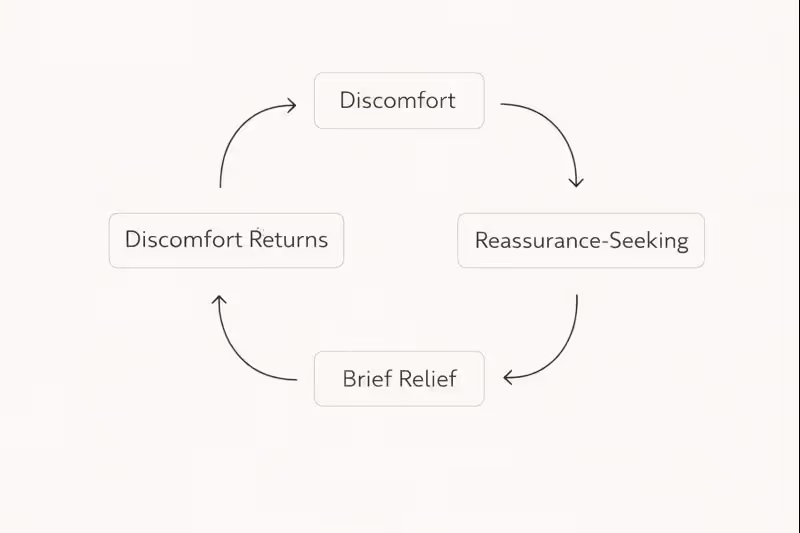
Normal social attunement crosses into compulsive territory when it creates a self-reinforcing loop: discomfort arises → you seek reassurance → temporary relief arrives → the relief fades quickly → discomfort returns stronger → you seek reassurance again.
Each cycle accomplishes two things simultaneously: it provides momentary calm and it deepens dependence on the external source. Over time, your tolerance drops — smaller uncertainties trigger the need, and the reassurance required to achieve relief escalates. The pattern mirrors addictive cycles structurally, even though it carries no formal diagnostic label.
Author: Daniel Rowland;
Source: ameliaearhartbook.net
Signs You're Stuck in Approval-Seeking
Recognition precedes intervention. These indicators often operate below conscious awareness until someone names them specifically.
Common Signs of Seeking Validation
- Over-apologizing or over-explaining decisions that require neither apology nor justification
- Difficulty sitting with uncertainty about how someone feels toward you — the ambiguity itself becomes intolerable
- Mood quality determined almost entirely by the latest piece of feedback received
- Checking social media metrics repeatedly and experiencing emotional shifts based on response volume
- Rehearsing conversations before they happen and dissecting them afterward for signs of disapproval
- Abandoning your own position the moment someone expresses disagreement
- Interpreting neutral silence as negative judgment by default
- Struggling to act on decisions without confirmation from at least one other person first
Approval-Seeking vs People-Pleasing
These overlap heavily but aren't identical. Approval-seeking targets the emotional reward — the internal signal that says "you're accepted." People-pleasing targets the behavioral strategy — agreeing, accommodating, suppressing needs — used to secure that reward.
Over time, chronic people-pleasing erodes confidence rather than building it. Every suppressed boundary teaches your system that your preferences carry less weight than someone else's comfort. The irony compounds: you sacrifice authenticity to maintain connection, but the connection you maintain isn't with the real version of you — so the validation it generates can never fully satisfy.
Work example: Your manager gives neutral feedback on a report. No criticism, no particular praise. You spend the next three hours analyzing the interaction, convinced the absence of enthusiasm signals disappointment. You rewrite sections that needed no revision, submit the updated version at midnight, and check email first thing the next morning hoping for reassurance.
Relationship example: After an ordinary evening with your partner — no conflict, no tension — you ask "Are you okay? Did I do something wrong?" three separate times. Your partner assures you everything is fine. The relief lasts approximately twenty minutes before the question resurfaces internally.
Social media example: You post a photo, then monitor notifications for the next hour. Twelve likes in the first ten minutes produces satisfaction. A twenty-minute gap with no new activity triggers doubt about whether the post was a mistake. You consider deleting it.
External Validation and Self-Esteem
The connection between habitual approval-seeking and self-worth runs deeper than surface-level insecurity.
How External Validation Reshapes Self-Worth
When approval functions as your primary worth barometer, something structural shifts: your sense of value gets outsourced. You no longer carry an internal reference point for "Am I okay?" — that determination gets delegated to whoever happens to be in your proximity.
This outsourcing creates a fragile architecture. Your self-assessment fluctuates based on variables entirely outside your jurisdiction — someone's mood, their communication style, whether they happened to check their phone. The result isn't low self-esteem in the traditional sense; it's unstable self-esteem — high when signals are positive, cratering when signals are absent or ambiguous.
Building Self-Worth Without Validation
Constructing self-worth that doesn't require constant external input involves redirecting the source of your self-assessment:
- Values alignment — identify what you actually stand for (not what earns applause) and measure your days against those principles rather than against other people's responses.
- Identity separation from output — practice distinguishing between "what I produce" and "who I am." Tying worth to performance creates the same dependency as tying it to approval — the variable just changes.
- Self-respect behaviors — adequate sleep, maintained boundaries, honesty even when it's uncomfortable. These function as tangible evidence that you treat yourself as someone who matters, regardless of external feedback.
Validation Addiction
This framing appears increasingly in mental health conversations — and while it carries useful explanatory power, it deserves careful handling.
What "Validation Addiction" Means (and What It Doesn't)
Validation addiction describes a compulsive pattern: the persistent, escalating need for external confirmation to manage internal distress. It shares structural features with behavioral addictions — tolerance development, withdrawal discomfort, continued engagement despite negative consequences.
It does not, however, constitute a formal clinical diagnosis. No entry exists in the DSM-5 for "validation addiction." The term functions as a descriptive framework — useful for recognizing patterns, less useful if it becomes another source of self-judgment ("Now I'm broken AND addicted").
The "Hit" Cycle
The mechanics follow a predictable loop:
Trigger (criticism, silence, uncertainty, social comparison) → Seeking behavior (asking for reassurance, fishing for compliments, checking metrics) → Brief relief (the approval lands, anxiety drops temporarily) → Crash (relief dissipates, baseline discomfort returns, often intensified) → Repeat (the cycle restarts with lower tolerance and higher urgency)
Breaking this loop requires intervention at the trigger stage rather than the seeking stage — by the time you're actively pursuing reassurance, the compulsive momentum is already running.
Validation-seeking often begins as an adaptive response to environments where approval was the only reliable signal of safety. The behavior made sense originally. The work lies in recognizing that the original conditions no longer apply — and that you now have the capacity to generate that safety internally.
— Dr. Nicole LePera, Clinical Psychologist
How to Stop Seeking Validation
Behavioral change here isn't about willpower or simply deciding to care less. It requires systematic disruption of deeply grooved patterns.
Identify Your Validation Triggers
Map the specific situations that activate your approval-seeking impulse. Common categories include:
- Receiving criticism (or perceiving it in neutral feedback)
- Encountering silence or delayed responses
- Making decisions without consensus
- Social comparison moments (scrolling feeds, attending events, hearing about peers' achievements)
- Situations requiring visibility or self-advocacy
Awareness of triggers doesn't eliminate them — but it creates a gap between stimulus and automatic response where deliberate choice becomes possible.
Replace Reassurance with Self-Validation
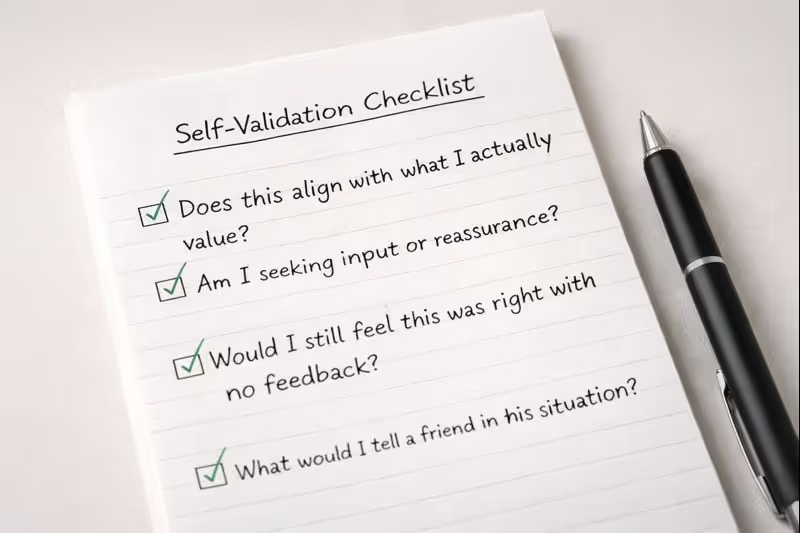
When the impulse to seek external confirmation arises, redirect toward an internal assessment first. A practical self-validation checklist:
- "Does this decision align with what I actually value?"
- "Am I seeking input because I need information, or because I need someone to tell me I'm okay?"
- "If no one ever commented on this choice, would I still feel it was right?"
- "What would I tell a friend making this exact decision?"
- "Can I sit with the discomfort of not knowing how this will be received?"
This isn't about never asking for input. It's about distinguishing genuine consultation from reassurance-seeking disguised as collaboration.
Author: Daniel Rowland;
Source: ameliaearhartbook.net
Set Boundaries That Protect Self-Worth
The people-pleasing → resentment → intensified approval-seeking loop operates as a closed circuit. Boundaries interrupt it at the source.
Start with one low-stakes boundary per week. Decline one request you'd normally accept out of guilt. State one preference you'd normally suppress. Allow one conversation to end without ensuring the other person feels positive about you.
Each maintained boundary deposits evidence that your needs carry legitimate weight — regardless of how anyone else responds to hearing them.
Build Confidence Through Evidence, Not Applause
Confidence rooted in external praise is structurally identical to validation dependency — it just looks better from the outside. Durable confidence forms through demonstrated competence, not received compliments.
Practical application: take one small risk per week where the outcome is skill-based rather than approval-based. Speak up in a meeting because you have relevant input, not to be perceived as contributing. Complete a project to your own standard before asking anyone to evaluate it. Track these instances — written evidence of capability counteracts the narrative that you need someone else to confirm your adequacy.

Author: Daniel Rowland;
Source: ameliaearhartbook.net
When to Consider Therapy
Independent work produces genuine results for many people. Professional support becomes particularly valuable when:
- Approval-seeking patterns trace back to trauma, chronic shame, or early attachment disruption
- Compulsive reassurance-seeking significantly impairs daily functioning or relationships
- Anxiety levels make it difficult to implement self-directed strategies consistently
- The pattern has resisted change despite sustained personal effort
CBT, ACT, and schema therapy each offer targeted frameworks for restructuring the belief systems and behavioral loops that maintain validation dependency.
Frequently Asked Questions
Key Takeaways
Seeking validation reflects deeply wired social instincts amplified by conditioning — not personal weakness. The pattern becomes costly when external approval operates as the sole regulator of your self-assessment, creating dependency on signals beyond your control.
- Definition: Seeking validation means relying on outside confirmation to determine your worth or the correctness of your choices
- Root causes: Evolutionary belonging needs, childhood conditional acceptance, environments linking value to output
- Key signs: Reassurance loops, mood instability tied to feedback, difficulty acting without external confirmation, chronic people-pleasing
- Core shift: Transitioning from externally sourced self-assessment to internally anchored self-regard built on values, evidence, and self-trust
- Next step: Identify your three most frequent triggers this week and practice one self-validation pause before acting on each