

Toxic Relationship: Signs, Mental Health Effects & What to Do Next | Full Guide
What Is a Toxic Relationship and Key Signs to Know

Content
Something feels off, but you can't quite name it. The relationship isn't all bad — there are good stretches, moments of real connection, days when everything feels fine. But underneath those moments runs a current of tension you can't shake. You monitor your words carefully. You brace for reactions. You spend more energy managing your partner's mood than living your own life.
That undercurrent — persistent, draining, and difficult to articulate to anyone outside the dynamic — is often the first signal that a partnership has crossed from imperfect into genuinely harmful territory.
This guide provides clear framing for what toxic actually means in relational context, the specific indicators that distinguish damaging dynamics from normal difficulty, how these patterns affect psychological and physical health, and practical guidance for deciding whether to repair or leave — along with concrete steps for either path.
If This Feels Uncomfortably Familiar
If you’re reading this while feeling anxious, unsettled, or on edge, pause for a moment before continuing. Take three slow breaths. Drop your shoulders. Unclench your jaw.
Nothing in this article requires immediate action or a snap decision. The goal isn’t to label your relationship or push you toward a conclusion — it’s to help you see patterns more clearly so you can decide your next steps from a grounded place rather than from fear or confusion.
Read slowly. Take breaks if needed. Insight works best when your nervous system feels relatively safe.
What Is a Toxic Relationship?
A toxic relationship is one characterized by repeated patterns that consistently erode the safety, respect, autonomy, or emotional wellbeing of one or both partners. The key word is patterns. Every couple includes moments of frustration, poor communication, or selfish behavior. What makes a dynamic harmful isn't a single bad day — it's the recurrence of destructive behaviors without meaningful change, accountability, or repair.
What does toxic mean in a relationship, practically? It means the dynamic operates in a way that diminishes you over time rather than supporting your growth. You feel smaller inside the partnership than outside it. Your confidence contracts. Your sense of reality gets questioned. Your needs get framed as excessive, inconvenient, or evidence of personal deficiency.
Toxic vs Unhealthy vs Abusive
These terms overlap but aren't synonymous, and the distinctions carry practical weight.
Unhealthy describes dynamics where communication is poor, frustrating patterns recur, and both partners contribute to the issues — but safety isn't compromised, and both people are capable of growth with effort and willingness.
Toxic describes dynamics where damaging behaviors have become entrenched, where one or both partners consistently undermine the other's wellbeing, and where the pattern resists change despite expressed pain. Power imbalance, manipulation, or emotional cruelty may be present.
Abusive describes dynamics involving coercion, control, intimidation, or violence — physical, sexual, emotional, or financial. Abuse is always toxic, but not all toxicity reaches the threshold of abuse.
If physical safety is at risk at any point, crisis resources take priority over self-assessment. The National Domestic Violence Hotline (1-800-799-7233) provides confidential support.
Signs of a Toxic Relationship
Recognizing toxicity from inside the dynamic is notoriously difficult — partly because harmful patterns often coexist with genuine affection, and partly because gradual erosion doesn't trigger the same alarm response as sudden crisis.

Author: Daniel Rowland;
Source: ameliaearhartbook.net
Control, Manipulation, and "Walking on Eggshells"
Control rarely announces itself directly. It enters through concern ("I just worry about you"), jealousy framed as devotion ("I only act this way because I love you so much"), or subtle monitoring that escalates incrementally — checking your phone, questioning your friendships, expressing displeasure about how you spend your time.
The hallmark experience: you begin editing yourself. You anticipate reactions before speaking. You modify plans, friendships, and self-expression to avoid triggering unpredictable responses. The phrase "walking on eggshells" appears in nearly every account of damaging dynamics because it captures the lived reality precisely — constant vigilance that consumes enormous mental bandwidth.
Chronic Criticism, Belittling, and Contempt
Constructive feedback targets specific behavior and comes wrapped in care. Destructive criticism targets identity — who you are rather than what you did. "You forgot to call" becomes "You're so thoughtless." "I disagree" becomes "You're being ridiculous."
Belittling operates through mockery, dismissive body language, eye-rolling, and the chronic minimization of your thoughts, feelings, or achievements. The "you're too sensitive" response to legitimate hurt is a particularly common pattern — it simultaneously invalidates your experience and repositions you as the problem.
Contempt — the communication of disgust or superiority toward a partner — represents the most corrosive element in relational research. Its consistent presence predicts partnership failure with extraordinary accuracy.
Instability Cycles
Harmful dynamics frequently operate in recognizable loops: intense conflict followed by intense reconciliation, harsh criticism followed by effusive apology, withdrawal of affection followed by sudden warmth. The oscillation itself becomes destabilizing — you never establish a baseline of safety because the ground keeps shifting.
Apologies arrive without behavioral change. Blame gets redirected toward you regardless of what happened. Guilt operates as a tool of control rather than an expression of genuine remorse. Over time, the cycle trains you to accept the damaging stretches as the price of the good ones.

Author: Daniel Rowland;
Source: ameliaearhartbook.net
Warning Signs — Checklist:
- Your partner's mood dictates the emotional temperature of the entire household
- You routinely suppress opinions, preferences, or feelings to prevent conflict
- Jealousy gets framed as evidence of love rather than addressed as controlling behavior
- Criticism targets who you are, not specific actions or situations
- You feel confused about your own reality after conversations ("Am I overreacting?")
- Apologies come frequently but behavior doesn't change
- Your friendships, family connections, or independent interests have contracted since the partnership began
- Affection or attention gets withdrawn as punishment when your partner is displeased
- You find yourself defending your partner's behavior to friends or family — or hiding it entirely
- Discussions about your needs get redirected to your partner's grievances
- Scorekeeping replaces generosity — favors get catalogued and leveraged
- You feel relief when your partner is away, followed by anxiety when they return
- Your self-worth has measurably declined since the partnership started
- Boundaries you've stated get ignored, tested, or treated as personal attacks
- The dynamic consumes disproportionate mental and emotional energy relative to what it provides
How to Read This Checklist
No single item defines a toxic relationship on its own.
What matters is pattern and impact.
- If only one or two items resonate occasionally, the dynamic may be strained but not inherently harmful.
- If several items feel consistently familiar — especially over months or years — the relationship is likely draining your wellbeing, regardless of intent.
- If reading the list triggered a sense of recognition mixed with relief (“I’m not imagining this”), that reaction itself is meaningful data.
You don’t need to check every box for a dynamic to be damaging. Repeated erosion of safety, autonomy, or self-trust is sufficient.
Scenario examples:
After a disagreement: You raised a concern calmly. Your partner responded by listing everything you've done wrong over the past six months, ended the conversation by going silent for two days, then acted as though nothing happened — without ever addressing your original concern.
Phone and privacy: Your partner checks your messages when you leave the room, questions unfamiliar contacts, and frames the behavior as reasonable concern. When you object, you're told "If you have nothing to hide, why does it matter?"
Keeping score: You declined a social event your partner wanted to attend. Three weeks later, during an unrelated disagreement, it resurfaces: "I went to your mother's dinner last month even though I didn't want to. You can't even do this one thing for me."
Affection withdrawal: After you expressed a boundary, your partner became cold — monosyllabic responses, no eye contact, sleeping on the far edge of the bed. No conversation about the boundary itself. The withdrawal persists until you apologize for raising it.
Relationship Affecting Mental Health
The psychological toll of sustained harmful dynamics extends well beyond relational dissatisfaction. Chronic exposure to unpredictability, criticism, and emotional manipulation produces measurable psychological and physiological effects.
Emotional Exhaustion in a Relationship
Living in a state of constant vigilance depletes cognitive and emotional resources at an accelerated rate. Emotional exhaustion manifests as persistent fatigue that sleep doesn't resolve, reduced capacity for concentration, diminished motivation in areas unrelated to the partnership, difficulty experiencing joy even in contexts that previously generated it, and a pervasive sense of heaviness that follows you throughout the day.
Hypervigilance — the constant scanning for your partner's mood, tone shifts, or potential displeasure — demands enormous mental bandwidth. That bandwidth gets subtracted from everything else: work performance, friendships, personal interests, basic self-care.
Emotional Burnout with a Partner
When exhaustion becomes chronic without relief, it transitions into burnout — a qualitatively different state characterized by detachment, numbness, and the collapse of caring capacity.
Burnout alongside a partner feels like being simultaneously drained and wired. You're too depleted to engage but too anxious to fully disengage. You stop bringing up issues — not because they've resolved, but because the cost of raising them exceeds whatever energy you have left. You go through relational motions mechanically. The version of yourself that existed before feels increasingly distant and difficult to access.
Chronic relational stress activates the body's threat response system on a sustained basis — elevating cortisol, disrupting sleep architecture, suppressing immune function, and increasing vulnerability to anxiety, depression, and trauma-related symptoms. Mental health and relationships are bidirectionally linked: the dynamic affects your wellbeing, and compromised wellbeing reduces your capacity to address the dynamic.
Can You Fix a Toxic Relationship?
This is the question most people in damaging dynamics grapple with longest — and the answer depends on specific conditions being met, not on hope, love, or history alone.
What "Repairable" Looks Like
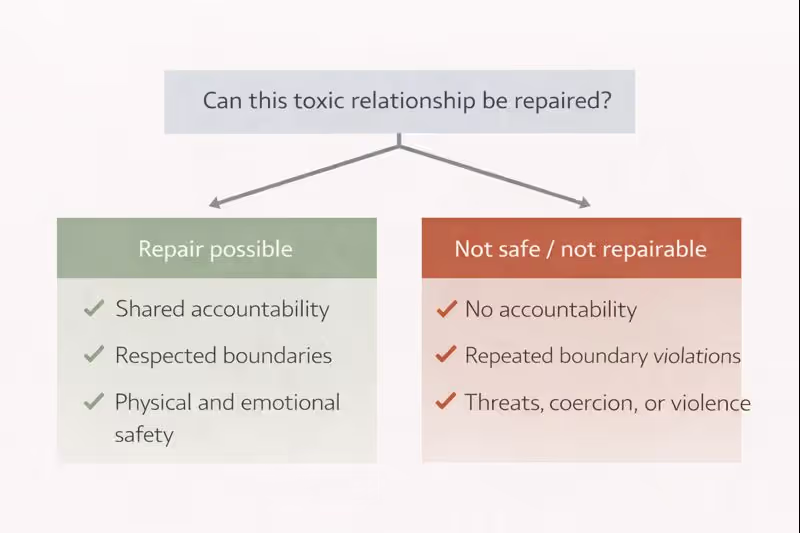
Repair becomes a realistic possibility when both partners can honestly name the harmful patterns without deflection, both accept accountability for their specific contributions, destructive behaviors stop — not gradually reduce, but stop — while new patterns are actively practiced, boundaries get respected consistently rather than tested, and professional support is engaged when the patterns exceed what self-directed effort can address.
The operative word is both. One partner doing all the recognizing, all the accommodating, and all the changing while the other continues damaging behavior isn't repair — it's continued harm with better camouflage.
What Is Not Repairable Through Self-Help
Certain dynamics require professional intervention as a prerequisite, and some are simply unsafe to remain within:
- Physical intimidation or violence of any kind
- Coercive control (financial, social, reproductive, digital)
- Escalating intensity of harmful behavior despite expressed pain
- Repeated boundary violations that follow a pattern of testing limits
- Refusal to acknowledge damaging behavior or accept professional guidance
Safety takes absolute priority. No communication technique, boundary framework, or couples exercise substitutes for physical and emotional security.
Damaging Pattern → Healthier Alternative → What Change Requires:
| Damaging Pattern | Healthier Alternative | What Change Requires |
| Criticism of character ("You're so lazy") | Complaint about behavior + specific request | Separating person from action; practicing "I" statements |
| Monitoring and control (phone checks, location tracking) | Trust built through transparency and respect | Addressing underlying insecurity; accepting partner's autonomy |
| Silent treatment as punishment | Structured time-outs with committed return | Emotional regulation skills; willingness to re-engage |
| Blame-shifting after conflict | Mutual accountability for impact | Ego flexibility; capacity to hold discomfort without deflecting |
| Affection withdrawal to manipulate | Consistent care independent of disagreements | Decoupling love from compliance; building unconditional baseline |
Deciding Whether to Repair or Leave
When people feel stuck, it’s often because they’re asking the wrong question.
Not “Is this relationship toxic?” but:
What evidence do I have that change is actually happening — or not?
Use the comparison below as a reality check, not a verdict.
Repair may be possible when:
- Harmful behaviors are acknowledged without minimization
- Accountability leads to sustained behavioral change, not just apology
- Boundaries are respected consistently, not tested repeatedly
- Both partners seek help voluntarily, not under threat of loss
- You feel safer over time, not more vigilant
Leaving becomes the healthier option when:
- Harmful patterns repeat despite clear communication
- Responsibility is deflected, reversed, or weaponized against you
- You’re doing most of the emotional labor to “keep things stable”
- Your wellbeing continues to decline while the relationship stays the same
- Hope is fueled by potential rather than observable change
Staying and leaving are both serious decisions. The absence of visible change is information — not a failure on your part.
How to Leave a Toxic Relationship Safely
Leaving is rarely a single moment of decision. It's a process — often non-linear, frequently complicated by practical entanglements, emotional bonds, and genuine fear.
Practical steps for the process:
- Build a support network before you exit. Identify trusted people — friends, family, a therapist, a hotline — who can provide emotional grounding, practical assistance, and reality-checking during a period when your judgment may feel compromised.
- Document if necessary. If the dynamic involves threats, intimidation, financial control, or any behavior that may require legal protection, maintain records in a location your partner cannot access.
- Secure logistics. Housing, finances, shared accounts, transportation — map the practical requirements in advance rather than navigating them under crisis pressure.
- Establish boundaries post-separation. Define contact terms clearly. Where safety permits, limited or no contact during the initial recovery period protects the emotional space needed for recalibration. Communicate boundaries in writing when possible.
Leaving When You Share Housing, Kids, or Finances
Entangled logistics don't make departure impossible — they make it require more planning. Identify which practical dependencies are genuine barriers and which function as rationalizations the dynamic itself generates to maintain its hold.
Consult professionals where needed: a family law attorney for custody questions, a financial advisor for shared account separation, a domestic violence advocate for safety planning in high-risk situations. This is not legal or financial advice — it's a recognition that complex exits benefit from specialized guidance.
After Leaving: Recovery and Rebuilding
The end of a damaging partnership doesn't produce immediate relief for most people. The nervous system that spent months or years in hypervigilant mode doesn't downshift overnight. Expect a period of recalibration that may include grief (even for a harmful dynamic), confusion about your own preferences and identity, difficulty trusting your judgment, and emotional volatility that feels disproportionate to your current circumstances.
This is normal recovery, not evidence that departing was the wrong decision. Rebuilding self-trust happens gradually — through small decisions honored, boundaries maintained, and the slow reacquisition of your own internal compass.
Author: Daniel Rowland;
Source: ameliaearhartbook.net
If This Article Raised Difficult Questions
You don’t need to solve everything at once.
Helpful next steps often look smaller and quieter than dramatic decisions:
- Talking through your observations with a therapist or counselor
- Writing down recurring patterns to counter minimization
- Reconnecting with people or interests that have shrunk over time
- Noticing how your body feels during and after interactions — calmer or more tense
- Giving yourself permission to gather information without committing to an outcome
Clarity tends to emerge gradually. Trust builds when your internal experience starts to make sense again.
How to Avoid Toxic Relationship Behaviors
Toxicity isn't always something that happens to you. Sometimes it's something you participate in — knowingly or not. Honest self-assessment here carries genuine courage.
Toxic Patterns Awareness
Preventing destructive dynamics starts with recognizing the seeds of harmful behavior before they establish roots.
Common early-stage patterns worth monitoring: difficulty tolerating your partner's independent friendships or interests, the impulse to check devices or monitor whereabouts, using withdrawal of affection to communicate displeasure instead of words, defaulting to character attacks rather than specific behavioral concerns, and framing controlling behavior as protection or care.
Awareness without behavioral change is insufficient — but change without awareness is impossible. Identify triggers, practice repair when you fall short, establish accountability structures, and treat emotional regulation as a core relational skill rather than an optional upgrade.
If You're the One Showing Harmful Behaviors
Recognizing damaging patterns in yourself — rather than exclusively in your partner — represents a fundamentally different and more demanding form of relational work.
Concrete starting points: name the specific behaviors (not vague "I can be difficult sometimes" framing — specific actions). Accept your partner's account of impact even when your intent differed. Engage individual therapy focused on the underlying drivers — insecurity, unprocessed trauma, learned relational models, regulation deficits. Understand that acknowledging the pattern doesn't resolve it; sustained behavioral transformation does.
Toxic Relationship Quotes
Distilled observations sometimes capture dynamics that longer explanations circle around.
Toxic relationships don't always look like what you'd expect. Sometimes they look like love — intense, consuming love that happens to leave you smaller each time.
— Dr. Ramani Durvasula, Clinical Psychologist
The takeaway here deserves emphasis: intensity isn't intimacy. The emotional extremes of harmful dynamics — the soaring highs after terrible lows — can neurochemically mimic deep bonding while structurally dismantling your wellbeing. Genuine love expands you. Destructive attachment contracts you. The felt experience may not immediately reveal which one you're in.
When someone shows you who they are, believe them the first time.
— Maya Angelou
Pattern recognition often conflicts with hope. You see the behavior clearly but rationalize it as temporary, situational, or provoked. Angelou's framing cuts through that rationalization: consistent behavior is information. Respond to the pattern, not the promise.
Frequently Asked Questions
Damaging partnerships operate through recurring patterns, not isolated bad days — and recognizing those patterns from inside the dynamic requires deliberate, honest assessment.
- Toxicity is defined by pattern and impact — repeated behaviors that erode safety, respect, or wellbeing despite expressed pain or stated boundaries
- The indicators span behavior and felt experience — control, criticism, instability cycles paired with exhaustion, confusion, and contracted self-worth
- Psychological effects are measurable and cumulative — chronic relational stress produces hypervigilance, burnout, and increased vulnerability to anxiety and depression
- Repair requires specific conditions — mutual accountability, stopped destructive behavior, respected boundaries, and professional support; one-sided effort doesn't qualify
- Departure is a process, not a moment — build support, plan logistics, establish post-separation boundaries, and expect a recalibration period
- Self-assessment matters too — identifying your own damaging patterns and pursuing genuine behavioral transformation takes courage and produces relational benefit beyond any single partnership
- Safety takes absolute priority — when physical intimidation, coercion, or violence are present, crisis resources and professional safety planning come first