

How to Communicate in a Relationship: Skills, Scripts & Habits That Actually Work | Guide
Communication in a Relationship Guide for Conflict Repair

Content
Most couples don't struggle because they lack love. They struggle because they lack a shared language for navigating the hard parts — the moments when needs collide, feelings get bruised, and the gap between what you meant and what your partner heard turns a Tuesday evening into a three-day standoff.
Healthy relationship communication isn't a personality trait some people are born with. It's a skill set — learnable, practicable, and remarkably specific. There are concrete techniques for how you open a difficult conversation, how you listen when you'd rather defend, and how you repair after things go sideways.
This guide covers the core frameworks that actually shift dynamics between partners: foundational skills, scripts you can use tonight, conflict-specific tools, and long-term habits that prevent small frustrations from compounding into resentment.
None of it requires perfection. All of it requires willingness to practice — imperfectly, repeatedly, and together.
Why Communication Matters in a Relationship
Communication in a relationship functions as the operating system that everything else runs on. Intimacy, trust, conflict resolution, shared decision-making, parenting coordination, financial planning — all of it depends on whether two people can accurately convey what they think, feel, and need, and whether the other person receives that message without critical distortion.
When the system works, disagreements get processed and resolved. Small needs get voiced before they harden into grievances. Vulnerability feels safe enough to risk. When the system breaks down, even minor issues calcify — not because the issues themselves are unsolvable, but because the channel for solving them has degraded.
The Goal Isn't "Never Fight" — It's Repair
A persistent myth suggests that good relationships don't involve conflict. Research consistently contradicts this. Couples who sustain long-term satisfaction aren't conflict-free — they're repair-competent. They argue, misunderstand each other, say things they regret. The distinguishing factor is what happens next.
Figuring out how to fix communication in a relationship starts with releasing the expectation that you'll stop disagreeing. The actual target: build a reliable process for circling back, acknowledging what went wrong, and reconnecting after rupture. Repair attempts — a softened tone, an apology, a moment of humor, a hand on the shoulder mid-argument — matter more than whether the argument happened at all.
The Foundations of Couples Communication
Before addressing conflict-specific tools, the baseline skills deserve attention. These operate in everyday exchanges — not just heated moments — and determine whether your partner generally feels heard, respected, and safe enough to be honest.
Active Listening That Makes Your Partner Feel Heard
Genuine listening — not waiting for your turn to rebut — remains the single highest-impact communication skill. When your partner speaks, particularly about something emotionally charged, the goal is reception before response.
Practical application: reflect back what you heard before offering your perspective. "It sounds like you felt dismissed when I made that decision without checking with you first." You're not agreeing — you're confirming that the message landed accurately. This single step defuses a surprising percentage of escalation, because most arguments intensify not over the original issue but over the feeling of not being heard.
Resist the urge to problem-solve immediately. Often your partner needs acknowledgment before solutions — and jumping to fixes communicates "let me skip past your feelings to the part I can control."

Author: Allison Monro;
Source: ameliaearhartbook.net
Speak with "I" Statements to Reduce Defensiveness
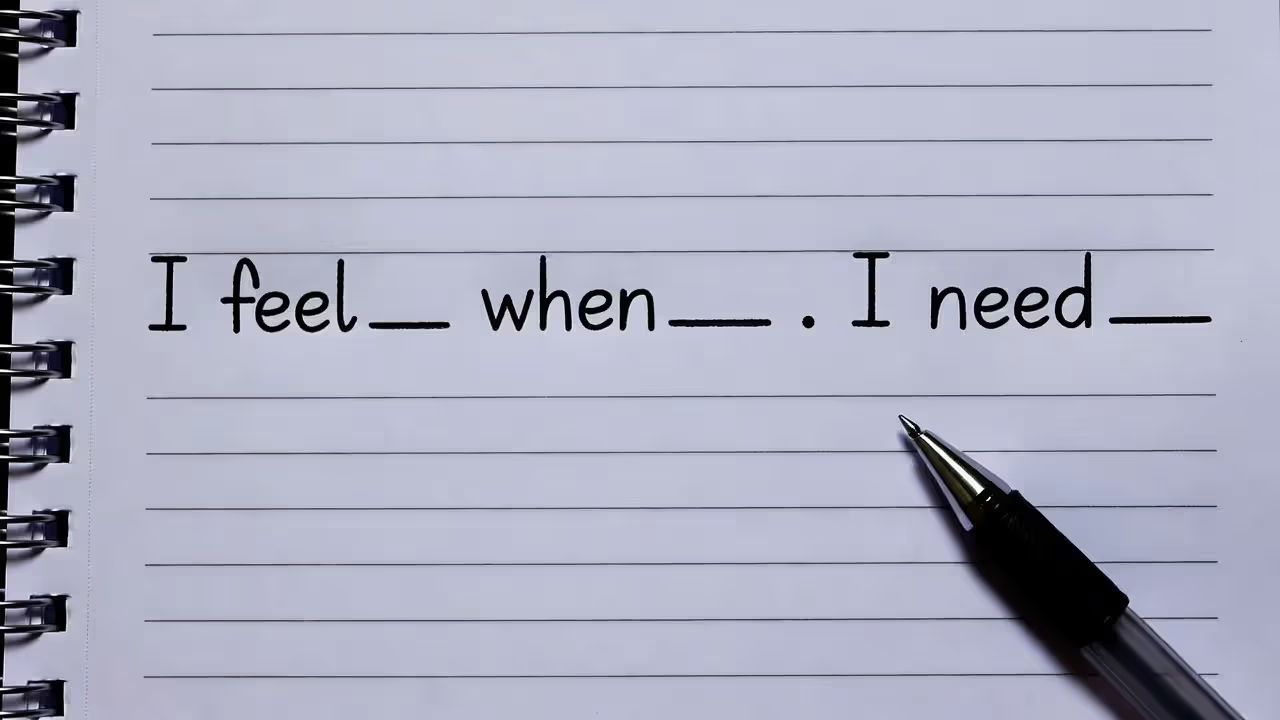
Learning how to communicate effectively with your partner involves restructuring how you frame complaints. "You never help around the house" triggers defense. "I feel overwhelmed when I handle cleanup alone most evenings" opens a door.
The formula is straightforward: "I feel (emotion) when (specific situation). I need/would like (clear request)."
Examples:
- "I feel anxious when we don't discuss big purchases beforehand. I'd like us to check in with each other on anything over $200."
- "I feel disconnected when we spend evenings on separate screens. I'd love to have dinner together without phones twice a week."
- "I feel hurt when my ideas get dismissed in front of friends. I need to feel like we're on the same team publicly."
The shift from "you" to "I" isn't about softening the message — it's about owning your emotional experience rather than assigning blame. The request at the end converts a complaint into a actionable proposal your partner can actually respond to.
Author: Allison Monro;
Source: ameliaearhartbook.net
Nonverbal Cues: Tone, Timing, and Body Language
Research estimates that the majority of emotional messaging travels through nonverbal channels — tone of voice, facial expression, posture, eye contact, physical proximity. You can deliver technically perfect "I" statements in a contemptuous tone and produce worse outcomes than a clumsy but genuinely warm attempt.
Pay particular attention to: crossed arms (signals closure), eye-rolling (signals contempt), turning away during conversation (signals dismissal), and checking your phone while your partner speaks (signals ranking). None of these may reflect your actual intent — but your partner responds to the signal, not the intention behind it.
How to Communicate Better in a Relationship
Moving from understanding principles to applying them in real time requires practical structure.
Choose the Right Moment (and Avoid Texting Fights)
Timing determines outcome more than most people recognize. Raising a sensitive topic when your partner is depleted, distracted, hungry, or mid-task almost guarantees a defensive response — not because the topic isn't valid, but because the receiving conditions are poor.
Guidelines: avoid initiating difficult conversations during transitions (arriving home, getting ready for bed), through text messages (tone is invisible and misinterpretation multiplies), or in the immediate aftermath of a triggering event (when emotional flooding impairs rational processing). Instead, request a specific time: "There's something I'd like to talk through — can we sit down after dinner tonight?"
Express Needs Calmly
One of the most consistently effective ways to improve communication in a relationship involves shifting from complaint language to need language. Complaints describe what's wrong; needs describe what would help.
The difference is structural:
Complaint: "You never ask about my day." Need: "I feel more connected when you ask how things went — even a quick check-in matters to me."
Complaint: "You always prioritize your friends over me." Need: "I need us to protect at least one evening a week that's just ours."
Expressing emotional needs in relationships requires vulnerability — which is precisely why many people default to criticism instead. Stating a need openly means admitting you want something from your partner, which can feel exposing. But needs stated clearly are dramatically easier to meet than needs buried inside accusations.
Script template you can adapt tonight:
"I feel ______ when ______ . What I need is ______ . Could we try ______ ?"
Assertive Communication with Your Partner
Assertiveness occupies the middle ground between suppression and aggression — and most couples default to one of the extremes rather than holding the center.

Author: Allison Monro;
Source: ameliaearhartbook.net
Assertive vs Passive vs Aggressive Communication
| Style | What It Sounds Like | Impact on Partner | Better Alternative |
| Passive | "It's fine, whatever you want." | Partner feels uneasy, senses unspoken resentment | "I'd actually prefer X — can we find a middle ground?" |
| Aggressive | "You're being selfish. You never think about me." | Partner shuts down or escalates defensively | "I feel overlooked when my preference isn't factored in." |
| Passive-aggressive | "No, go ahead. I'll just handle everything myself. Again." | Partner feels manipulated, trust erodes | "I'm frustrated about the workload split. Can we revisit it?" |
| Assertive | "This matters to me. Here's what I need, and I want to hear what works for you too." | Partner feels respected; dialogue opens | — (this is the target) |
Assertive communication with your partner doesn't mean getting your way every time. It means your needs enter the conversation clearly, your partner's needs get equal airtime, and the resolution reflects both rather than one person's comfort purchased at the other's expense.
Boundaries and Requests (Without Ultimatums)
Healthy boundaries differ from ultimatums in one critical way: boundaries describe what you will do; ultimatums threaten what you'll do to your partner.
Ultimatum: "If you go out with your friends again this Friday, we're done." Boundary: "I need at least one weekend evening together each week to feel connected. If that consistently doesn't happen, I'll need to reassess whether my needs can be met in this dynamic."
The second version communicates the same seriousness without weaponizing the relationship itself. It states a need, names a consequence you control, and leaves room for collaborative problem-solving.
How to Fix Communication in a Relationship During Conflict
Conflict is where communication patterns face their hardest test. These tools apply specifically to heated moments — when emotional stakes are high and habitual reactivity is strongest.
Use a Gentle Start-Up
How a conversation begins predicts how it ends with remarkable accuracy. A harsh start-up — criticism, blame, contempt in the opening sentence — triggers defensive lockdown almost immediately.

Author: Allison Monro;
Source: ameliaearhartbook.net
Gentle alternative: lead with a specific observation, not a character judgment. Address behavior, not identity. And include what you need, not just what went wrong.
Harsh: "You're so inconsiderate. You forgot our plans again." Gentle: "When our plans get forgotten, I feel like I'm not a priority. Can we figure out a system that works for both of us?"
How to communicate better with your spouse during disagreements starts here — at the first sentence. Get that right and the rest of the conversation has dramatically better odds.
Stick to One Issue and Slow the Pace
"Kitchen-sinking" — piling multiple grievances into a single argument — guarantees overwhelm and ensures nothing gets resolved. When you notice the conversation expanding ("And another thing..."), pause and redirect: "I want to address those other issues too, but let's finish this one first."
Slow the pace physically. Drop your speaking speed. Insert pauses. Ask one question and wait for a complete answer before responding. Speed signals threat to the nervous system; deliberate pacing signals safety.
Take a Break Before You Say Something You Can't Unsay
When emotional flooding hits — racing heart, raised voice, the sensation that you're about to say something regrettable — call a structured timeout. Not a storming-off, door-slamming exit. A deliberate pause with a return commitment.
Script: "I need to take a break — I'm getting too activated to communicate well. Let's come back to this in 30 minutes."
The return commitment matters. Walking away without it communicates abandonment; walking away with a specific return time communicates self-regulation.

Author: Allison Monro;
Source: ameliaearhartbook.net
Conflict Checklist
Do:
- Soften your opening sentence
- Validate one thing your partner said before responding with your perspective
- Ask one clarifying question before assuming intent
- Propose one concrete next step
Don't:
- Mind-read ("You obviously don't care about...")
- Name-call — even "mild" labels damage trust cumulatively
- Use global statements ("You always..." / "You never...")
- Bring up past resolved issues as ammunition
Improving Communication in Relationships Long-Term
Crisis-mode tools handle acute conflict. Sustained improvement requires structural habits that prevent issues from accumulating in the first place.
Weekly Check-Ins (Prevent Issues from Piling Up)
A brief, scheduled weekly conversation — 20 to 30 minutes — functions as routine maintenance for the relationship. Structure it simply:
Appreciation — each person names one specific thing the other did that week that they valued. Needs — anything unaddressed that needs airtime (raised gently, using the frameworks above). Logistics — upcoming schedule coordination, practical decisions. Repair — any lingering tension from the week that hasn't been fully resolved.
The predictability matters. When both partners know there's a reliable venue for raising concerns, the urgency to address every frustration in real time decreases — which reduces reactive conflict significantly.

Author: Allison Monro;
Source: ameliaearhartbook.net
Build the Habit of Appreciation and Small Bids for Connection
Relationships erode less through dramatic betrayals than through accumulated small missed connections. Your partner makes a comment about something they saw today — that's a bid for engagement. Your response (turning toward it with interest vs. ignoring it vs. dismissing it) deposits or withdraws from the relationship's emotional account.
Consistent small positives — a genuine compliment, an unprompted question about their day, physical affection without agenda, remembering a detail they mentioned — build a reservoir of goodwill that makes conflict significantly easier to navigate when it arrives.
When Communication Problems Signal a Bigger Issue
Not all communication breakdowns are skills deficits. Some patterns indicate deeper dynamics that require professional intervention:
- Contempt has become a regular feature of exchanges — mockery, sneering, dismissive eye-rolling
- One partner feels physically or emotionally unsafe during disagreements
- Stonewalling (complete emotional withdrawal) occurs routinely and resists repair attempts
- The same argument cycles repeatedly with no movement toward resolution despite genuine effort
- Communication has deteriorated to the point where basic daily coordination feels adversarial
In strong relationships, partners turn toward each other's emotional bids at least 86% of the time. When that ratio drops significantly, it signals disconnection that typically requires structured support to reverse.
— The Gottman Institute, Relationship Research
Couples therapy isn't a last resort reserved for relationships on the verge of collapse. It's a structured environment for learning and practicing communication skills with guided feedback — and it tends to produce better outcomes the earlier it's accessed.
Frequently Asked Questions
Key Takeaways
Effective communication in a relationship operates as a learnable skill set, not an innate talent — and small structural changes in how you speak, listen, and repair produce disproportionately large improvements.
- Listen before you respond — reflect back what you heard before offering your perspective; most escalation stems from feeling unheard, not from the original disagreement
- Use "I" statements with genuine requests — "I feel ___ when ___ . I need ___ " replaces blame with actionable dialogue
- Match your nonverbal signals to your words — tone, posture, and eye contact carry more emotional weight than content
- During conflict: soften your start-up, stick to one issue, take structured breaks — these three habits alone prevent the majority of destructive escalation
- Build maintenance habits — weekly check-ins and daily small bids for connection prevent issues from compounding into resentment
- Seek professional support proactively — couples therapy works best as early intervention, not last resort