

Rebuild Trust in a Relationship: Steps, Exercises & How to Feel Secure Again | Guide
How to Rebuild Trust in a Relationship Step by Step

Content
Trust doesn't shatter the way glass does — suddenly and obviously. More often it erodes through accumulated dishonesty, broken commitments, or a single devastating revelation that reframes everything you thought you knew about your partnership. Either way, the aftermath feels remarkably similar: a disorienting mix of hurt, hypervigilance, and the agonizing question of whether what's fractured can genuinely be mended.
The honest answer: sometimes it can. But rebuilding trust in a relationship bears no resemblance to the simplified version — where one person apologizes, the other forgives, and everything resets. Real restoration is behavioral, not verbal. It happens through sustained, observable action over months — not through promises, however sincere they sound in the moment.
This guide covers the full arc: what relational confidence actually consists of, what needs to stabilize before restoration can begin, specific roadmaps for recovery after deception and after infidelity, practical exercises that generate evidence rather than just good intentions, and honest guidance for recognizing when progress has stalled.
Why Trust Breaks and What "Rebuild Trust" Really Means
Relational confidence operates on three pillars: predictability (your partner does what they say they'll do), truthfulness (the information they share is accurate), and care under pressure (they protect the partnership even when doing so feels inconvenient or uncomfortable).
When any pillar fractures, the entire structure destabilizes. Security after emotional pain doesn't return through a single conversation, a heartfelt letter, or a weekend away. It returns through accumulated behavioral evidence — consistent, observable, repeated proof that the conditions which led to the breach have genuinely changed.
This distinction matters because many couples attempt restoration through emotional intensity rather than behavioral consistency. Grand gestures, tearful apologies, and passionate recommitments produce temporary relief but don't address the core deficit: the hurt partner's nervous system no longer classifies the dynamic as safe. Only sustained, reliable demonstration of changed conduct recalibrates that classification over time.

Author: Allison Monro;
Source: ameliaearhartbook.net
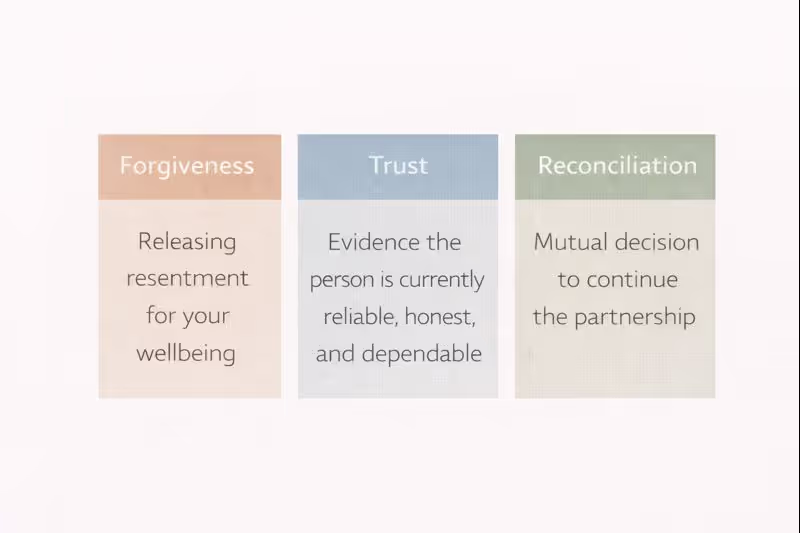
Trust vs Forgiveness vs Reconciliation
These three concepts get conflated constantly, creating confusion about what's actually required.
Forgiveness is an internal process — releasing the grip of resentment for your own wellbeing. It doesn't require the other person to change, and it doesn't restore safety.
Trust is an evidence-based assessment — your nervous system's verdict on whether this person is currently reliable, honest, and dependable. It requires observable proof, not emotional declarations.
Reconciliation is a mutual decision to continue the partnership, contingent on ongoing behavioral change. It requires both forgiveness and restored confidence — but neither one automatically produces the other.
You can forgive someone completely and still not feel secure with them. You can choose reconciliation and still need months of evidence before genuine safety returns. Understanding this prevents the damaging expectation that forgiveness should function as an instant reset button.
Author: Allison Monro;
Source: ameliaearhartbook.net
Relationship Healing Steps Before You Try to Repair
Jumping directly into restoration mode before the emotional ground stabilizes typically backfires. Certain conditions need to be established first.
Stabilize the emotional environment. Stop the escalating investigation spirals — the compulsive checking, the interrogation marathons at 2 AM, the cyclical arguments that cover the same territory without resolution. These are understandable responses to betrayal, but they prevent the regulated state both partners need for productive work.
Agree on a "repair container." Define parameters for difficult conversations: scheduled times (not ambushes), agreed-upon tone expectations, time limits, and a protocol for when either person becomes too activated to continue productively.
Two Tracks of Healing
Emotional repair in a relationship requires both partners to carry specific responsibilities simultaneously.
What the hurt partner needs: validation that their pain is legitimate and proportional, clear and complete information about what happened, established boundaries that feel genuinely protective, and patience with a recovery timeline they don't control.
What the partner who caused the breach must do: full accountability without minimizing or deflecting, transparent behavior offered voluntarily rather than extracted through surveillance, consistent follow-through on stated commitments, and tolerance for the hurt partner's ongoing questions and emotional fluctuations without treating them as punishment.
Prerequisite Checklist — Restoration Cannot Proceed Without These:
- The harmful behavior has fully stopped (not reduced — stopped)
- The accountable partner takes ownership without conditions or counter-blame
- Both partners agree the dynamic is worth preserving
- A commitment exists to honesty going forward, including uncomfortable truths
- Both people are willing to seek professional support if self-directed efforts stall
- Emotional and physical safety is intact for both partners
If these conditions aren't present, efforts will sit on an unstable foundation — producing temporary improvement that collapses under the first real stress test.
How to Rebuild Trust in a Relationship After Lying
Dishonesty creates a specific rupture: the hurt partner can no longer rely on information received from the person closest to them. Every past statement becomes suspect. The internal question shifts from "What happened?" to "What else don't I know?"
To regain a partner's confidence after deception, the process must address both the specific lie and the broader reliability deficit it created.
Full ownership without semantic escape routes. "Technically I didn't lie" or "I just didn't mention it" deepens damage rather than mending it. Acknowledge what you did, why it was harmful, and what drove the choice to deceive — without positioning yourself as the victim of circumstances.
Clean honesty going forward. Commit to truthfulness as active practice, including proactive disclosure of information your partner would want to know — not just avoiding direct falsehoods. Answer questions without defensiveness, even when they feel repetitive or accusatory. The repetition reflects unresolved anxiety, not malicious intent.
Transparency Without Turning the Dynamic Into Policing
Openness agreements provide structure during the fragile early stages of recovery. They might include voluntary sharing of whereabouts, open device access for a defined period, or proactive communication about situations the hurt partner finds triggering.
The critical distinction: visibility offered voluntarily strengthens relational security. Surveillance imposed unilaterally erodes it. When monitoring becomes the mechanism — constant location checking, covert phone inspections, interrogation after every social interaction — the dynamic shifts from recovery to control. The hurt partner's anxiety may decrease temporarily, but genuine safety doesn't actually develop because the evidence is extracted rather than generated.
Healthy openness agreements have defined scope, a review timeline, and a shared understanding that the goal is eventual reduction — not permanent installation.
Damaging Habits → Constructive Alternatives → What It Looks Like This Week:
| Damaging Habit | Constructive Alternative | This Week's Action |
| Lying about whereabouts | Proactive communication about plans | Share your schedule voluntarily each morning |
| Hiding financial activity | Shared visibility into spending | Review accounts together Sunday evening |
| Minimizing when confronted | Full acknowledgment of impact | When your partner raises a concern, reflect it back before explaining |
| Shutting down during hard conversations | Staying present even when uncomfortable | Agree to one 20-minute conversation with no walkouts |
| Broken small promises | Consistent follow-through on stated commitments | Keep three specific promises this week and name them when completed |
How to Rebuild Trust After Cheating or an Affair
Infidelity creates deeper structural damage than other forms of dishonesty because it ruptures the exclusivity agreement most partnerships are built upon. The hurt partner often experiences trauma-like responses — intrusive thoughts, hypervigilance, emotional flooding, disrupted sleep, difficulty concentrating — that reflect genuine nervous system dysregulation, not melodrama.
Restoring safety in a marriage or committed partnership after infidelity requires specific conditions beyond standard recovery work.
End all contact with the affair partner. Completely, verifiably, and without negotiation. Continued communication — even "just to provide closure" — signals that the unfaithful partner's comfort takes priority over the hurt partner's security.
Create explicit safety agreements. These address the specific anxieties infidelity generates: communication about whereabouts, visibility regarding device use, agreements about social situations, and willingness to answer questions — repeatedly if necessary — about what happened.
Commit to sustained long-term work. Infidelity recovery isn't a weeks-long sprint. Credible research and clinical experience converge on a timeline measured in months to years. Short-term reassurance without structural behavioral change produces false recovery that collapses under pressure.
A Structured Method Couples Recognize
The Gottman Method outlines three distinct phases for affair recovery:
Phase 1 — Atonement: The unfaithful partner demonstrates genuine understanding of the pain caused, answers questions patiently, and provides consistent non-defensive accountability. The hurt partner's emotional responses are validated, not managed or rushed.
Phase 2 — Attunement: Both partners examine what made the dynamic vulnerable — without blaming the hurt partner for the affair. Communication, emotional responsiveness, and conflict management skills get rebuilt.
Phase 3 — Attachment: The couple consciously creates a new narrative that integrates what happened without being defined by it. Intimacy and connection develop on a more honest foundation.
Common Pitfalls
Rushing closure. Pressure to "move past it" before the hurt partner has fully processed — often driven by the unfaithful partner's discomfort with ongoing pain — short-circuits genuine healing and produces resentment.
Trickle truth. Disclosing information in fragments over time — each revelation reopening the wound and resetting the recovery clock. Full, early disclosure (ideally guided by a therapist) causes more initial pain but enables cleaner healing.
Making the hurt partner responsible for the pace. "I've apologized — when are you going to let this go?" shifts the burden onto the person who didn't create the problem. Recovery timelines belong to the wounded partner, not the one who caused the breach.
Couples who recover from infidelity are not those who never struggle — they are the ones who commit to a long, often painful process of restoration, guided by genuine accountability and a shared decision that the partnership is worth the effort.
— Dr. John Gottman, The Science of Trust
Trust Building Exercises That Create Evidence
Abstract commitment means little without concrete behavioral proof. These activities generate the observable evidence that nervous systems require.
Daily micro-commitments. Each partner states one small promise each morning ("I'll be home by 6:30" / "I'll ask about your meeting tonight") and follows through without reminder. The scale is intentionally modest — the goal is flawless consistency, not impressive scope.
Openness ritual. Once daily, share one thing your partner would want to know but might not think to ask about — a concern, a feeling, a detail about your day. This trains voluntary disclosure as a habit rather than a response to interrogation.
Check-in protocol. Weekly, 15 minutes: What happened this week that affected our sense of security? What did I hear in your answer? What will I do with that information? This structured format prevents sessions from devolving into unstructured processing spirals.
Short Exercises You Can Do This Week
- Listening drill (10 minutes). One partner speaks for 3 minutes about how the breach affected them. The other listens silently, then reflects back what they heard — without correcting, defending, or reframing. Switch roles. The goal is accurate reception, not agreement.
- Boundary articulation exercise. Each partner writes down three boundaries they need honored during the recovery process. Share them. Discuss which ones you can commit to immediately and which need negotiation. Post them somewhere visible.
- Weekly review. Every Sunday, each person names: one moment this week where safety felt stronger, one moment where it felt threatened, and one specific action for the coming week. Track these over time — the written record provides tangible evidence of trajectory.
Questions to Rebuild Trust in a Relationship
Structured questions create scaffolding for conversations that would otherwise spiral. Use these grouped by purpose, not all at once.
Understanding What Happened
- "What were you feeling or avoiding when you made that choice?"
- "What's the complete timeline of what occurred?" (if relevant — particularly after infidelity)
- "Was there a moment where you considered a different path? What stopped you?"
- "What do you understand now about the impact that you didn't grasp then?"
Setting New Agreements
- "What level of openness do we both consider reasonable without becoming adversarial?"
- "What boundaries need to be in place going forward?"
- "How will we handle it when one of us gets triggered?"
- "What's our agreed protocol when security feels shaky — who initiates and how?"
Measuring Change
- "What specific behaviors will I see from you in the next 30 days?"
- "How will I know at 60 days that things have genuinely shifted?"
- "What does accountability look like when you fall short — not if, but when?"
Repair Conversation Framework:
Hurt partner: "When (specific event) happened, I felt (emotion). What I need from you going forward is (concrete request)."
Restoring partner: "I hear that you felt (reflected emotion). I take responsibility for (specific action). Here's what I'll do differently: (concrete commitment with timeline)."
Both: "How will we check in on this? When will we revisit whether it's working?"
How to Trust Your Partner Again
Learning to feel secure again isn't a decision you make once — it's a capacity that returns gradually as evidence accumulates and your nervous system recalibrates.
Distinguish triggers from genuine red flags. After betrayal, your alarm system becomes hypersensitive. A delayed text response may trigger the same panic as a discovered lie. Learning to differentiate — "Is this my nervous system reacting to the past, or is this current evidence of a real problem?" — prevents false alarms from derailing genuine progress.
Develop internal confidence alongside relational security. Rely on your own capacity to set and enforce boundaries. Recognize your ability to identify warning signals accurately. Know that you will protect yourself if the situation requires it. This foundation of self-assurance reduces the desperate quality of depending on your partner — because you know you'll be okay either way.

Author: Allison Monro;
Source: ameliaearhartbook.net
A Realistic Timeline
There is no universal schedule. General patterns observed clinically: initial stabilization takes weeks to a few months. Genuine restoration of security after a significant breach typically requires six months to two years of consistent behavioral evidence. After infidelity, the deeper end of that range is common.
Progress arrives in waves — not a straight upward line. Good weeks will be followed by triggered weeks. A song, a location, an anniversary date can resurface pain that felt resolved. These setbacks don't indicate failure — they indicate that healing is nonlinear, which it always is.
The metric that matters: are the stable stretches getting longer and the triggered periods getting shorter and less intense? If yes, the trajectory is sound. If not after sustained effort, professional guidance becomes important.
When Rebuilding Trust Isn't Working
Not every breach is mendable — and recognizing stalled recovery prevents both partners from remaining in a limbo that serves neither.

Author: Allison Monro;
Source: ameliaearhartbook.net
Signs that progress has stalled:
- Dishonest behavior continues or new deceptions surface
- The accountable partner refuses ongoing responsibility ("I already apologized — how long do I have to keep doing this?")
- Blame-shifting persists — the hurt partner gets repositioned as the cause of the problem
- Openness agreements get violated or quietly abandoned
- One partner carries all the effort while the other passively waits for things to normalize
- Emotional or physical safety is compromised at any point
Individual therapy can address personal blocks. Couples therapy provides structured guidance when self-directed efforts have plateaued. Both represent investments in the dynamic, not admissions of failure.
Frequently Asked Questions
Key Takeaways
Restoring relational security is a behavioral process measured in months, not a conversational event measured in hours. It requires specific conditions, sustained effort, and realistic expectations from both partners.
- Accountability comes first — full ownership without minimizing, deflecting, or counter-blaming establishes the foundation everything else rests upon
- Openness is offered, not extracted — voluntary visibility strengthens the dynamic; surveillance and interrogation erode it
- Consistency outweighs intensity — small promises kept daily generate more evidence of reliability than grand gestures followed by relapse
- Structured activities create tangible proof — micro-commitments, check-ins, and guided conversations produce the observable evidence nervous systems require
- Timelines belong to the hurt partner — rushing closure serves the accountable partner's comfort, not the recovery process
- Self-assurance supports relational security — confidence in your own boundaries and judgment reduces the desperate quality of depending on someone else's reliability
- Stalled progress deserves honest assessment — if conditions for recovery aren't met or maintained, professional support or reconsideration of the dynamic are both legitimate next steps