

Emotional healing concept with person journaling and processing feelings
Why Emotional Healing Takes Time and How It Works

Content
Emotional healing is the work of processing painful experiences until they lose their grip on your daily functioning. Not forgetting. Not performing positivity. Not hitting some arbitrary deadline where you’re supposed to feel fine.
You still carry the memory, but the electrical charge fades. A situation that once threw your entire nervous system into overdrive gradually becomes bearable — present in your awareness but no longer dominating it. Emotional recovery isn’t the wound vanishing — it’s the wound closing, scarring, and no longer dictating how you move through an ordinary afternoon.
Our culture packages healing as a performance goal. “Choose happiness.” “Stay grateful.” “Let it go.” These slogans aren’t healing — they’re detour signs painted to look like directions. Genuine emotional healing operates at a pace and messiness that no caption can contain.
Emotional Healing vs Emotional Suppression
The most pervasive counterfeit of healing is suppression — burying the feeling and labeling it resilience. On the outside, suppression looks fine — you function, you smile, you claim you’re good. Internally, the unprocessed emotion accumulates like compound debt, showing up as persistent muscle tension, emotional numbness, or explosive reactions that seem disproportionate to the trigger.
Suppression keeps the feeling locked away. Healing gives it passage through. One generates chronic pressure. The other generates gradual relief.
The Emotional Healing Process
How Emotional Healing Works
The emotional healing process moves through three broad phases: recognition, direct experience, and integration. First you identify what you’ve been carrying. Then you permit the full experience of it without rushing the exit. Finally, the experience gets woven into your larger personal narrative rather than standing alone as the thing that defines you.
In lived reality, these phases rarely unfold in sequence. Progress appears on Thursday and vanishes by Saturday. A specific scent drags you back without warning. A mundane weekday hits harder than the anniversary. The process has its own rhythm, and that rhythm ignores your calendar.
Research identifies two non-negotiable conditions for healing: psychological safety and emotional expression. You need a context — internal or relational — where the feeling can surface without punishment. And you need an outlet — language, movement, tears, creative work — that moves the trapped material outward. Remove either ingredient and the process stalls.
Author: Lauren Whitestone;
Source: ameliaearhartbook.net
Stages of Emotional Healing
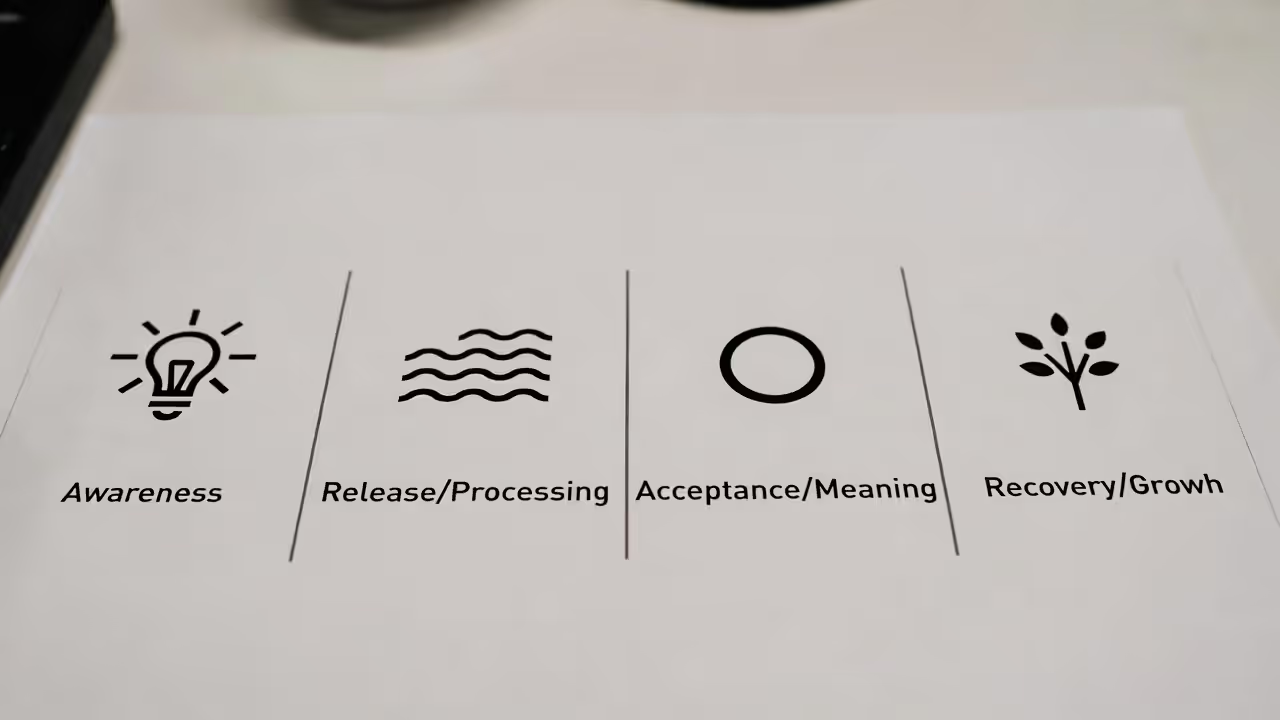
These stages overlap, reverse, and sometimes collide. Naming them lets you locate yourself in the process and recognize motion even when everything feels static.
Stage 1 — Awareness and Acknowledgment
Nothing heals until it’s identified. This stage demands honest admission: something damaged you. The relationship, the grief, the professional collapse, the betrayal — it left residue. You are not fine.
This is frequently the steepest barrier. It requires discarding the internal script that says “why hasn’t this passed already” and facing what’s actually present. Acknowledgment needs no performance. Sometimes it’s as quiet as sitting alone and thinking: “That broke something in me. And it hasn’t mended yet.”
Stage 2 — Emotional Release and Processing
After recognition, stored material starts surfacing. This phase can manifest as unexpected tears, anger detached from any obvious cause, heavy fatigue, intense dreams, or a compulsive urge to narrate the experience aloud.
Processing is not intellectual analysis on repeat. It’s letting the emotion travel rather than caging it. Directed journaling helps. So does talking with a person who hears without jumping to solutions. Anything that offers the feeling a passage out — rather than another sealed container — qualifies.
Stage 3 — Acceptance and Meaning
Acceptance is not endorsement. It means you release the cognitive loop of “this should not have happened” and redirect attention toward what follows.
Meaning tends to emerge without being forced. You begin identifying what the experience exposed — unspoken needs, recurring patterns, reserves of resilience you hadn’t tested before. This isn’t repackaging suffering as a gift. It’s the brain’s natural drive toward coherence. The pain doesn’t dissolve, but it acquires a function beyond pure damage.
Stage 4 — Rebuilding and Growth
The closing stage involves re-engaging with ordinary life from an altered foundation. You’ve changed — and that shift isn’t a deficiency. Post-pain growth doesn’t retroactively justify what happened. It signals that you’ve metabolized the experience and now function from a wider internal map.
Rebuilding varies enormously. Entering new relationships with sharper awareness. Changing professional direction. Or simply completing a full day without the persistent weight that once felt permanent. The marker: choice replaces reaction.

Author: Lauren Whitestone;
Source: ameliaearhartbook.net
The Emotional Healing Journey
Why Healing Is Not Linear
Weeks of steady improvement followed by an unexplained crash don’t signal regression. They’re a standard feature of the emotional healing journey — the process cycling through its own necessary rhythms.
Recovery moves in oscillations rather than a clean upward slope. Dormant triggers re-emerge. Specific dates carry disproportionate weight. A new situation that echoes the original wound peels it open momentarily. This pattern signals reprocessing — the nervous system revisiting identical material at successively deeper strata.
Therapists frequently invoke the spiral staircase image: you keep facing the same window, but your elevation has shifted each time you pass it.
Signs You Are Mentally Healing
Progress inside the process is hard to detect in real time. Retrospectively, specific shifts become visible:
- Trigger responses compress. An event that would have leveled you for a full week now lands as a sharp pang that dissipates within hours.
- You notice your own patterns mid-activation rather than discovering them in the aftermath.
- You can narrate the difficult experience without your nervous system replicating the original flood of sensation.
- Self-blame around the experience loses its adhesive. You stop assigning yourself responsibility for outcomes that weren’t solely yours.
- Your decisions start reflecting desire rather than avoidance.
Proof that you are mentally healing never looks like unbroken good mood. It looks like a stabilizing foundation — fewer crashes, shorter dips, a center of gravity that holds even when surface weather turns rough.

Author: Lauren Whitestone;
Source: ameliaearhartbook.net
Ways to Heal Yourself Emotionally
Theory alone has a low ceiling. Past a certain point, only consistent action moves the needle. If you’re wondering how to heal yourself emotionally, the practical answer is: daily disciplines maintained across months — not a single cathartic breakthrough.
Daily Practices for Emotional Healing
- Directed journaling. Not open-ended venting — structured inquiry. Prompts that work: “What am I carrying right now? When did this originate? What would actually help?” Five minutes of focused writing outperforms sixty minutes of looping rumination.
- Physical release work. Stored emotion lodges physically — braced muscles, constricted breathing, chronic restlessness. Walking outdoors, gentle stretching, restorative yoga, or two minutes of slow diaphragmatic breathing begin dislodging what cognitive processing can’t access.
- Sleep architecture. REM sleep is when the brain consolidates emotional processing. Chronic sleep disruption arrests recovery at a neurobiological level. Fixed sleep-wake timing, screens off 60 minutes before bed, and a darkened, cool bedroom aren’t luxury — they’re foundational infrastructure.
- External scaffolding. Internal chaos is more tolerable when external structure remains stable. Consistent wake times, predictable meals, and a handful of non-negotiable daily anchors create a container that supports the deeper emotional work running underneath.
Emotional Healing Techniques
Once daily foundations are in place, targeted emotional healing techniques deepen and accelerate the work:
- Mindful witnessing. Sitting with an activated emotion for 90 seconds to two minutes — locating it physically, observing its texture and movement — trains the prefrontal cortex to observe rather than be hijacked. Repeated daily, this measurably weakens the emotion’s behavioral grip.
- Self-compassion protocol. Kristin Neff’s research confirms that self-directed compassion engages the same calming neural circuits as external comfort. During self-criticism spikes, try: “This is painful. Pain is universal. I can meet myself with kindness here.”
- Interpretation testing. Catching a fixed narrative and subjecting it to scrutiny. “They abandoned me because I’m inadequate” becomes “The relationship failed for reasons involving both of us.” This isn’t denial — it’s calibration.
- Somatic attention. Clenched jaw. Compressed chest. Knotted gut. These physical signals encode unresolved emotional material. Directing non-judgmental awareness toward them — without forcing them to change — initiates a release cycle the conscious mind alone cannot trigger.
What happens when people open their hearts? They get better.
— Haruki Murakami, Norwegian Wood
Emotional Healing Therapy
When Therapy Can Help
Independent practice handles a wide range of emotional injuries. Certain categories, however, exceed what solo methods can safely process:
- Locked trauma. When memories remain intrusive, sensorially vivid, and accompanied by strong bodily activation months or years post-event, targeted modalities — EMDR, somatic experiencing — can reach material that self-directed practice cannot.
- Entrenched low mood or chronic anxiety. When acute emotional pain has hardened into a chronic baseline state, professional scaffolding provides the structural support to disassemble patterns that appear immovable from the inside.
- Recurring self-defeating loops. If identical relationship dynamics, burnout spirals, or self-sabotage patterns keep re-emerging despite intellectual understanding, a therapist can surface the buried drivers that intellectual insight alone cannot shift.
Therapy vs Self-Healing
These are complementary layers, not competing alternatives:
| Dimension | Self-Healing | Therapy |
| Best for | Everyday emotional processing, daily resilience building | Trauma, complex grief, entrenched patterns |
| Pace | Self-directed, adaptable | Structured, clinician-guided |
| Tools | Journaling, mindfulness, somatic work, social support | EMDR, CBT, DBT, somatic experiencing, IFS |
| Limitations | Cannot safely access deep unconscious material alone | Requires financial investment, scheduling, right fit |
| Optimal role | Ongoing maintenance | Targeted intervention for specific wounds |
In practice, the strongest results come from layering both: clinical sessions for heavy structural repair, independent practice for routine emotional upkeep.
Practical Examples of Emotional Recovery

Author: Lauren Whitestone;
Source: ameliaearhartbook.net
After a breakup. The opening weeks are visceral. Emotional recovery begins the moment you stop tracking their digital footprint and start interrogating what the relationship exposed about your own attachment wiring. You mourn the future that evaporated. You let anger exist without weaponizing it. Months on, the constant ache narrows to an occasional pang that arrives and departs on its own.
After a loss. Grief follows no external schedule. Emotional recovery after losing someone close has nothing to do with “closure” — it’s the slow process of bearing the absence without being flattened by it. Six months out, a memory that would have shattered you early on now draws a bittersweet half-smile. At a year, the person remains with you but differently — woven in rather than pressing down.
After burnout. Burnout recovery goes beyond rest — it requires restructuring your relationship with productivity and personal value. Emotional recovery requires identifying the internal compulsion that overrode your limits and disconnecting personal value from professional output. The marker of healing: declining requests without shame and resting without the low hum of guilt.
Expert Insights on Emotional Healing
Healing does not mean the damage never existed. It means the damage no longer controls your life.
— Akshay Dubey
All three voices converge on one point: scars remain visible, and flawlessness is irrelevant. What it does demand is willingness — to feel with accuracy, to sit inside discomfort, and to trust the trajectory even when you can’t see where it bends.
Emotional healing isn’t a fixed destination. It’s a developing capacity — the ability to absorb pain without being structurally compromised by it and to emerge altered but operational. The stages exist but don’t behave like a checklist. The timeline belongs to you. The techniques are instruments, not guarantees.
The only metric that matters is direction. Are you turning toward what hurts rather than constructing elaborate detours around it? Are you extending to yourself the same patience you’d grant someone you care about?
If the answer is yes — even partially, even on the worst days — the process is already underway.
FAQ About Emotional Healing