

Self soothing practice with hand on chest and calm breathing
What Is Self Soothing and How It Helps Calm Anxiety

Content
Self soothing meaning, at its core, is straightforward: it’s the deliberate act of calming your nervous system when it’s activated by stress, anxiety, or emotional overload. What is self soothing in practical terms? It’s what happens when you place a warm hand on your chest during a panic spike, run cool water over your wrists when frustration peaks, or breathe slowly until your heart rate drops from racing to steady.
The key distinction: self soothing is not about making emotions disappear. It’s about creating enough internal stability to experience them without being overwhelmed. You don’t suppress the sadness, the anger, or the fear. You give your body the signal that it’s safe enough to process what’s happening rather than shutting down or spiraling.
Self Soothing vs Emotional Suppression
These look similar from outside but produce opposite results internally. Suppression pushes emotions below conscious awareness — the feeling gets buried, not resolved. It often resurfaces later as irritability, physical tension, chronic headaches, or emotional numbness that you can’t quite trace back to a specific cause.
Self soothing keeps the emotion present while reducing physiological activation. You still feel the sadness — but your breathing is regulated, your muscles aren’t locked, and your prefrontal cortex stays engaged enough to make decisions. The emotion gets processed through the body rather than stored in it.
The practical test: after suppression, you typically feel flat or disconnected. After genuine self soothing, you feel calmer but still emotionally present — like the volume was turned down without the signal being cut entirely.
Why Self Soothing Is Important for Adults
Self Soothing and the Nervous System
Your autonomic nervous system operates in two primary modes. The sympathetic branch activates your stress response — elevated heart rate, shallow breathing, muscle tension, narrowed attention. The parasympathetic branch governs recovery — slower pulse, deeper breathing, relaxed muscles, broader cognitive access.

Author: Lauren Whitestone;
Source: ameliaearhartbook.net
Nervous system soothing works by deliberately engaging the parasympathetic branch. When you breathe slowly, apply warmth, or use grounding touch, you’re sending afferent signals through the vagus nerve that shift the balance from alarm toward regulation. This isn’t metaphorical — it’s measurable physiology.
For adults, this matters because adult life generates chronic low-grade activation that rarely triggers full fight-or-flight but keeps the sympathetic system partially engaged for hours. Self-soothing behaviors adults practice counteract this background tension before it accumulates into anxiety, insomnia, or burnout.
Self Soothing for Anxiety and Emotional Overwhelm
Anxiety self soothing targets the specific pattern where threat perception exceeds actual danger. Your brain registers a deadline, a difficult conversation, or an uncertain outcome as genuinely dangerous — and your body responds accordingly.
Self soothing techniques for anxiety interrupt this cycle at the body level. Rather than arguing with the anxious thought (which often amplifies it), you address the physiological activation directly. Once the body calms, the mind frequently follows — not because the problem disappeared, but because your cognitive resources came back online.
Self Soothing Skills You Can Use Anytime
Sensory Self Soothing Techniques
Author: Lauren Whitestone;
Source: ameliaearhartbook.net
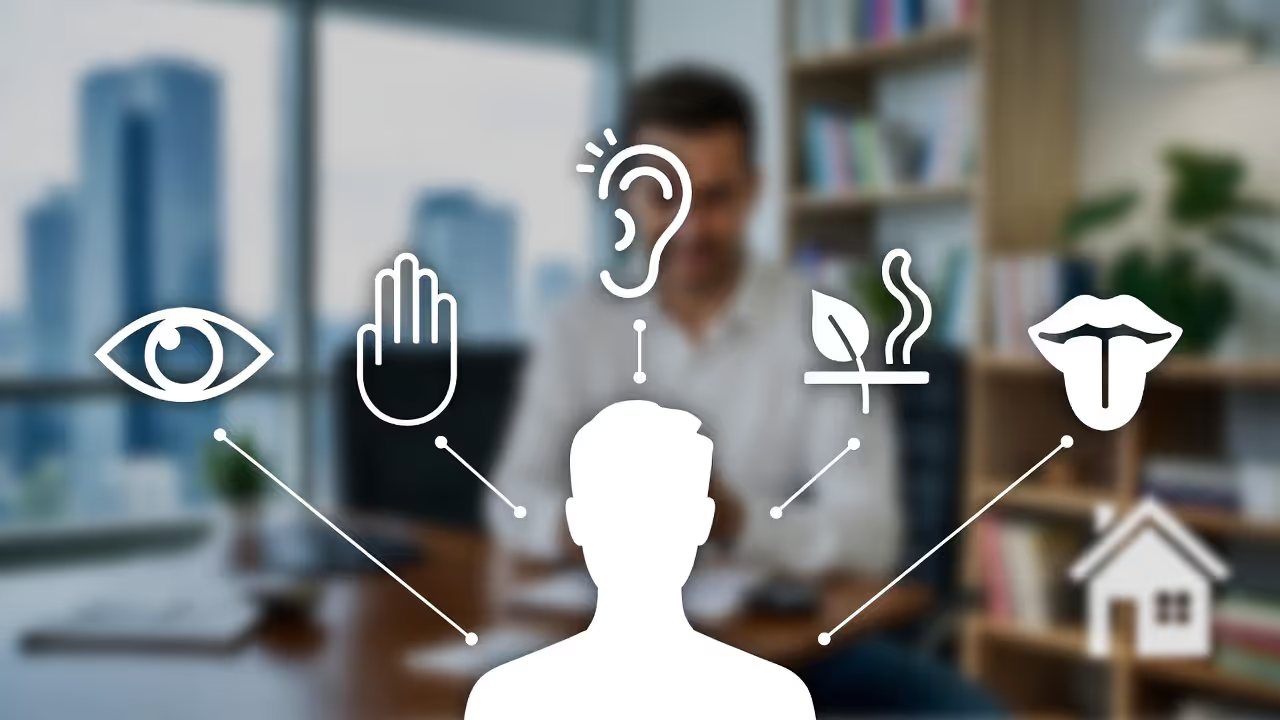
Sensory-based self soothing skills work because they redirect attention from internal rumination to immediate physical input. Each sense offers a direct pathway to nervous system regulation:
Touch. Hold something warm — a heated mug, a microwaved cloth, your own hands pressed together. Weighted blankets, textured fabrics, or simply placing both palms flat on a cool surface. Touch activates pressure receptors that communicate safety to the brainstem.
Sound. Low-frequency sounds — rain recordings, deep instrumental music, humming. Your own humming stimulates the vagus nerve through vocal cord vibration. Nature sounds reduce cortisol measurably within minutes.
Smell. Lavender, eucalyptus, familiar comfort scents — a partner’s clothing, a childhood smell. Olfactory input bypasses the thalamus and reaches the amygdala directly, making scent one of the fastest emotional regulators available.
Sight. Slow-moving visual input: candlelight, clouds, water. Looking at nature photographs for 40 seconds lowers cortisol. Soft, warm lighting signals evening and safety to the circadian system.
Taste. Warm beverages (non-caffeinated). A small piece of dark chocolate eaten slowly. Mint or ginger tea. Deliberate tasting — holding liquid in your mouth, noticing temperature and flavor — engages the present-moment attention that anxiety disrupts.
Self-soothing skills help regulate emotions when external comfort isn’t available.
— Marsha Linehan
Practical Self Soothing Techniques for Adults
Body-Based Soothing Activities
Physical soothing activities engage the nervous system directly, bypassing the cognitive loops that often keep stress activated. These emotional calming tools are accessible regardless of setting:
- Physiological sigh. Double inhale through the nose (two short breaths in), followed by one extended exhale through the mouth. Stanford research identifies this as the fastest single-breath method for reducing sympathetic arousal. Effective in under 30 seconds.
- Warm water immersion. Submerge hands in warm water for 60 seconds. The temperature change activates peripheral vasodilation and parasympathetic engagement. Works at any sink.
- Bilateral self-touch. Cross arms and alternate tapping each shoulder slowly — the “butterfly hug” from EMDR practice. Bilateral stimulation produces a measurable calming effect by engaging both hemispheres.
- Progressive muscle release. Tense one muscle group (hands, shoulders, jaw) for five seconds, then release completely. The contrast between tension and release amplifies the parasympathetic signal. Move through three to four groups in under two minutes.
Mental and Emotional Self Soothing Strategies

Author: Lauren Whitestone;
Source: ameliaearhartbook.net
Self soothing strategies that operate through cognitive and emotional channels complement the body-based approach:
- Compassionate self-talk. Not affirmations — genuine acknowledgment. “This is hard right now. I’m allowed to feel this way. I can take the next step when I’m ready.” The tone matters more than the specific words. Address yourself as you would a friend you respect.
- Containment journaling. Write the distressing thought or feeling on paper. Close the notebook. The physical act of externalizing and then enclosing creates a symbolic boundary that reduces rumination intensity. Five minutes is sufficient.
- Safe-place visualization. Close your eyes and construct a specific location — real or imagined — where you feel genuinely safe. Populate it with sensory detail: temperature, light, sounds, textures. Spend 60 to 90 seconds there. This activates the same neural networks as actual environmental safety.
These emotional comfort habits work best when practiced during calm periods so they’re accessible during high-stress moments. A technique rehearsed ten times in safety activates faster under pressure than one attempted for the first time during crisis.
Ways to Self Soothe During Anxiety or Stress
Quick Self Soothing When You Feel Overwhelmed
When emotional intensity peaks, you need methods that work within one to five minutes. These ways to self soothe function as emergency regulation — not resolution, but stabilization:
The 30-second reset. One physiological sigh. Both feet flat on the floor. Name five things you can see. This combination addresses breathing, grounding, and attentional redirection simultaneously.
Cold water contact. Splash cold water on your face or hold ice cubes briefly. Cold activates the dive reflex — an involuntary parasympathetic response that lowers heart rate within seconds. Particularly effective during panic.
Pressure grounding. Press your back firmly against a wall. Push your feet into the floor. Grip a solid object tightly for ten seconds, then release. Deep pressure input overrides the floating, dissociative quality of overwhelm.
Long-Term Self Soothing Habits
Sustained resilience requires preventive self soothing routines — not just crisis response:
- Morning nervous system check-in. Two minutes before any screen: notice body tension, take three slow breaths, set one intention for emotional care. This establishes a regulated baseline before stimulation begins.
- Midday micro-soothing. A 90-second pause at the day’s midpoint. Step away from the task, close your eyes, and perform one sensory grounding exercise. This prevents cumulative activation from reaching the threshold where crisis intervention becomes necessary.
- Evening wind-down protocol. Thirty minutes before sleep: dim lighting, warm beverage, no news or social media. This signals the circadian system to begin melatonin production and allows the nervous system to downshift from daytime vigilance.
Self Soothing as a Distress Tolerance Skill

Author: Lauren Whitestone;
Source: ameliaearhartbook.net
In Dialectical Behavior Therapy (DBT), self soothing occupies a specific role within distress tolerance skills — the category of techniques designed for moments when emotions are too intense for problem-solving or rational processing.
The DBT framework recognizes that certain emotional states temporarily exceed the window of tolerance — the range within which you can feel distressed and still function. When you exceed that window, logic doesn’t help. Reframing doesn’t help. What helps is sensory and physiological intervention that brings activation back within manageable range.
Self soothing through the five senses is one of DBT’s core distress tolerance modules precisely because sensory input works when cognitive tools cannot. It meets the nervous system where it actually is — in activation — rather than where you wish it were. Marsha Linehan developed this protocol specifically for clients whose emotional intensity outpaced standard cognitive-behavioral techniques, and the approach has since become standard across multiple therapeutic modalities.
Examples of Self Soothing in Daily Life
At work, before a difficult meeting. You step into the restroom, run warm water over your hands for 30 seconds, take two physiological sighs, and return. No one noticed. Your heart rate is ten beats lower. Your voice will be steadier.
Before sleep, when thoughts are racing. You place a hand on your chest, breathe against the gentle weight, and slowly name objects in the room until the mental loop loses momentum. You don’t resolve the worry — you downregulate the activation around it.
During a conflict, when anger rises. You excuse yourself for two minutes. You press your back against the hallway wall, grip your own wrist, breathe. You return to the conversation from a regulated state rather than a reactive one. The difference in outcome is significant.
When anxious thoughts spike unpredictably. You notice the chest tightening, the shortened breath. You don’t argue with the thought. You hum a low tone for ten seconds, press your feet into the floor, and let the parasympathetic system answer the sympathetic alarm. The spike passes. It was going to pass anyway — but active soothing shortens the duration from twenty minutes to four.
Expert Insight on Self Soothing
Between stimulus and response there is a space. In that space is our power to choose our response.
— Viktor Frankl
The shared principle: your capacity to comfort yourself during difficulty is not indulgence — it’s the foundation upon which all other emotional functioning depends.
FAQ About Self Soothing
Self soothing is a skill, not a personality trait. It can be learned at any age, improved with practice, and adapted to virtually any setting. The techniques described here — sensory, physical, cognitive — all share a common mechanism: they communicate safety to a nervous system that has registered threat.
Needing to comfort yourself is not weakness. It’s a recognition that adult life generates more emotional activation than any person can simply absorb without tools. Having specific, practiced methods for regulation is as practical as having a first-aid kit — not because you expect injury, but because preparation makes recovery faster when disruption inevitably arrives.
Start with one technique. Practice it five times when you’re calm. Then reach for it when you need it. The skill builds from there — not through intensity, but through repetition.