

Mental rest as quiet, screen-free recovery
What Is Mental Rest and Why Your Brain Needs It

Content
What is mental rest? It’s the deliberate reduction of cognitive and emotional load to allow your brain’s processing, attention, and decision-making systems to recover. What is the meaning of mental rest in daily terms? It means creating intervals where your mind is not solving, planning, analyzing, worrying, or consuming new information.
Physical rest restores muscles and joints. Mental rest restores attention, clarity, and the capacity to regulate emotions. Without it, your brain operates in a state of continuous partial engagement — never fully working, never fully recovering, and progressively losing efficiency in both.
The critical nuance: mental rest is not the absence of activity. It’s the absence of cognitive demand. You can be physically active — walking, stretching, gardening — and mentally resting at the same time, provided the activity doesn’t require sustained focus or decision-making.
Mental Rest vs Physical Rest
The difference between physical rest and mental rest explains why so many people feel exhausted despite adequate sleep and downtime.
Physical rest addresses muscular fatigue, joint recovery, and cardiovascular restoration. Lying on a couch, sleeping, and reducing physical exertion accomplish this effectively.
Mental rest addresses attentional depletion, decision fatigue, emotional processing overload, and sensory overstimulation. These systems don’t recover through physical stillness alone. You can lie motionless for hours while your mind races through tomorrow’s to-do list, replays a difficult conversation, and scrolls through catastrophic scenarios — and stand up more depleted than when you lay down.
The practical implication: if you feel exhausted after a full night’s sleep or a “relaxing” weekend of screen-based entertainment, the deficit is almost certainly mental, not physical. Your body recovered. Your brain did not.
Why Mental Rest Is Important for Mental Health
Brain Fatigue and Mental Exhaustion
Understanding why is rest important for mental health starts with recognizing what happens when cognitive systems operate without adequate recovery.

Author: Daniel Rowland;
Source: ameliaearhartbook.net
Your prefrontal cortex — the brain region responsible for planning, decision-making, impulse control, and emotional regulation — runs on a limited daily budget. Every decision, every email requiring judgment, every social interaction demanding tact, every suppressed frustration draws from this account. Brain fatigue recovery becomes necessary when the account depletes faster than it replenishes.
The symptoms of mental exhaustion are distinctive: difficulty concentrating despite effort, increased irritability over minor issues, a feeling of being “done” by midafternoon, inability to make simple decisions without disproportionate strain, and a pervasive mental fog that rest doesn’t seem to clear.
Emotional and Nervous System Overload
Mental fatigue doesn’t operate in isolation. When cognitive resources deplete, emotional regulation degrades simultaneously. You become more reactive, less patient, more prone to interpreting neutral events as threatening.
Emotional rest — the recovery of your capacity to process feelings without overwhelm — requires its own dedicated space. It doesn’t arrive automatically through sleep or passive entertainment.
Similarly, your nervous system needs periodic downshifting. A nervous system pause — intentional moments where sensory input decreases and the sympathetic stress response can deactivate — prevents the cumulative arousal that eventually manifests as chronic tension, sleep disruption, or anxiety that seems to appear without cause.
Types of Mental Rest
Author: Daniel Rowland;
Source: ameliaearhartbook.net
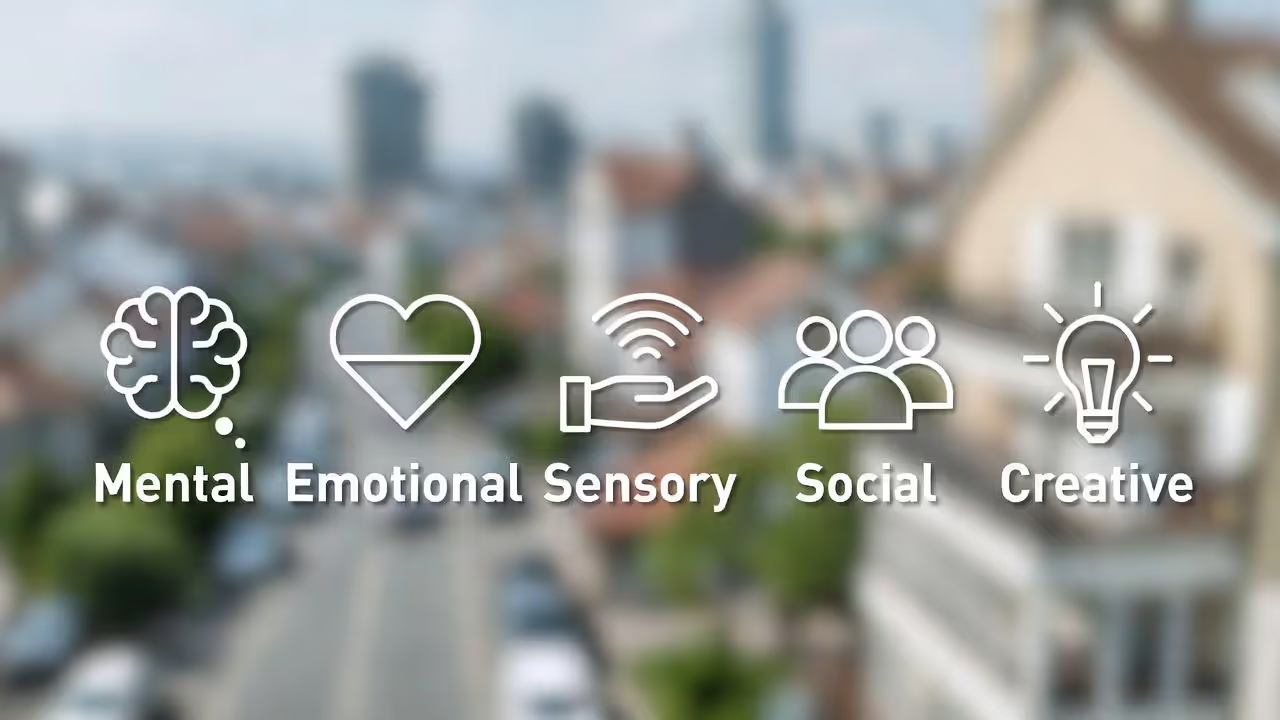
The question what are the 7 types of mental rest comes from Dr. Saundra Dalton-Smith’s research identifying distinct recovery categories. Each addresses a different dimension of depletion:
Cognitive Rest
Recovery from sustained thinking, problem-solving, and information processing. Needed when your mind feels cluttered, your focus scatters, and simple tasks require disproportionate effort. Addressed through thought breaks, reduced decision load, and deliberate monotasking.
Emotional Rest
Recovery from emotional labor — the effort of managing, suppressing, or performing emotions. Needed when you feel numb, irritable without clear cause, or emotionally flat despite adequate sleep. Addressed through honest emotional expression, reduced people-pleasing, and boundaries around emotional availability.
Sensory Rest
Recovery from environmental overstimulation — screens, notifications, noise, artificial lighting, visual clutter. Needed when ordinary sounds or lights feel grating, when you crave silence, or when you feel overstimulated in spaces that previously felt comfortable. Addressed through reduced screen exposure, quiet environments, and intentional periods of low sensory input.
Creative Rest
Recovery from the pressure to produce, innovate, and generate solutions. Needed when inspiration feels forced and creative work produces frustration rather than flow. Addressed through exposure to beauty without output pressure — nature, art, music consumed purely for its own sake.
Social Rest

Author: Daniel Rowland;
Source: ameliaearhartbook.net
Recovery from interpersonal demands — conversation, performance, emotional management of others’ needs. Needed when social interaction feels draining regardless of the people involved. Addressed through solitude, reduced social commitments, and time spent with people who require minimal performance.
Spiritual Rest
Recovery from disconnection with meaning, purpose, or belonging. Needed when daily activities feel mechanically productive but personally hollow. Addressed through practices that reconnect you with values, community, contribution, or awe — whatever generates a sense of participation in something larger than task completion.
Physical Rest (as a Supporting Type)
While distinct from mental rest, physical recovery supports cognitive restoration. Sleep quality, muscle tension release, and reduced physical strain create the biological conditions under which mental recovery becomes possible. Chronic physical tension or sleep disruption actively blocks the other six types.
The mind is not a vessel to be filled, but a fire to be kindled.
— Plutarch
How to Get Mental Rest
Cognitive Rest Techniques
The question of how to get mental rest begins with reducing the volume of information and decisions your brain processes daily. These cognitive rest techniques target the specific systems that deplete fastest:
- Stimulus restriction windows. Designate 30 to 60 minutes daily where no new information enters — no news, no social media, no podcasts, no email. This allows your attention system to move from intake mode to consolidation mode, processing what’s already accumulated rather than absorbing more.
- Monotasking blocks. Perform one task at a time with all competing inputs closed. Multitasking doesn’t divide attention equally — it forces rapid, metabolically expensive context-switching. Monotasking lets cognitive resources concentrate instead of scatter.
- Micro-breaks between cognitive tasks. A 90-second pause — eyes closed, no input — between focused work periods allows the prefrontal cortex to partially reset. This isn’t laziness. It’s maintenance. The research on distributed rest consistently shows that frequent short breaks preserve accuracy and speed more effectively than sustained unbroken effort.
- Decision pre-loading. Choose tomorrow’s clothes, meals, and primary task the night before. Every eliminated morning decision preserves capacity for the choices that actually require judgment.
Knowing how to mental rest effectively means accepting that your brain has a finite daily processing budget — and spending it deliberately rather than letting it leak through ambient stimulation.
Emotional Rest Practices

Author: Daniel Rowland;
Source: ameliaearhartbook.net
Emotional rest practices restore the internal bandwidth that constant emotional management consumes:
- Permission to not perform. Identify one relationship or setting where you can express what you actually feel rather than what’s expected. This single outlet can prevent the accumulation of emotional debt that eventually surfaces as shutdown or breakdown.
- Boundary-based recovery. Decline one non-essential social obligation per week. Not permanently — just as a deliberate preservation of emotional resources during periods of high demand.
- Expressive writing. Ten minutes of unstructured journaling about whatever occupies your emotional foreground. The act of externalizing emotional content reduces the cognitive load of carrying it internally. No structure required — stream of consciousness serves the function.
Rest is not inactivity. It is the restoration of mental and emotional capacity.
— Dr. Saundra Dalton-Smith
How to Rest From Mental Exhaustion
Mental Downtime Habits
Learning how to rest from mental exhaustion requires building deliberate non-productive time into your routine — not as reward after completion, but as structural necessity for continued function.
- Intentional boredom. Sit without stimulation for ten minutes. No phone, no book, no task. Your brain enters default mode network activity — a state associated with memory consolidation, creative incubation, and emotional processing. This feels uncomfortable initially because modern life has systematically eliminated unstimulated intervals. The discomfort fades within a few sessions as your system recalibrates.
- Offline transition periods. Build a 20-minute analog buffer between work and personal time. Walk without earbuds. Prepare a meal manually. The absence of digital input allows your nervous system to shift gears rather than carrying work-mode arousal into evening hours.
- Deliberate mental downtime habits like low-demand hobbies. Activities requiring gentle physical engagement but minimal cognitive load — knitting, casual walking, simple cooking, plant care — give the analytical brain rest while keeping the body lightly occupied. These outperform passive screen consumption because they don’t generate new processing demands.
Nervous System Reset Moments
When mental exhaustion has accumulated, targeted nervous system interventions produce faster state change than waiting for natural recovery:
Extended exhale breathing. Inhale for four counts, exhale for seven. The lengthened exhale directly activates vagal tone and parasympathetic engagement. Three rounds shift measurable autonomic markers within 90 seconds.
Physical deceleration. Deliberately slow every movement for five minutes — walking, pouring water, reaching for objects. Speed reduction interrupts the urgency signal that sustained activation produces and communicates safety to the motor-sensory system.
Grounding through temperature. Hold something warm or apply something cool to the back of your neck. Temperature contrast engages peripheral receptors that compete with and partially override cognitive stress signals.
Practical Examples of Mental Rest

Author: Daniel Rowland;
Source: ameliaearhartbook.net
After a dense workday. You close the laptop at 6 PM but your brain continues processing the final project for hours. Mental rest intervention: a 20-minute walk without audio input, followed by a manual task (cooking, cleaning) that engages motor systems while releasing cognitive hold. By 7:30, the prefrontal cortex has genuinely disengaged rather than carrying work into the evening.
During information overload. You’ve consumed three hours of news, responded to 40 messages, and processed two complex reports. Your attention feels scattered and nothing sticks. Mental rest intervention: 30 minutes with all screens off, one cup of tea consumed in silence, and a brief body scan from head to feet. You don’t need more input — you need processing time for what’s already in.
In the middle of emotional stress. A conflict with a family member has been replaying in your mind for days. Mental rest intervention: ten minutes of expressive writing about the situation (not to solve it, but to externalize the loop), followed by 15 minutes of a low-demand sensory activity — music, warmth, gentle movement. The emotional load doesn’t vanish, but the compulsive replaying loses intensity.
Expert Insight on Mental Rest
Almost everything will work again if you unplug it for a few minutes — including you.
— Anne Lamott
The connecting principle: mental rest isn’t unproductive time stolen from your schedule. It’s the infrastructure that makes everything on your schedule possible.
FAQ About Mental Rest
Mental rest doesn’t happen by accident in a world designed to capture and hold attention continuously. It requires the same intentionality you’d apply to any other essential maintenance — not as luxury, but as operating requirement.
The practices are accessible: a stimulus-free window, a walk without input, a deliberate pause between tasks, an evening where the screen stays dark. None require special equipment, extended time, or clinical intervention. They require only the recognition that your brain’s processing capacity is finite and that spending it deliberately produces better results than letting it drain through ambient overload.
Rest your mind the way it actually needs to be rested — not just your body. The clarity, patience, and creativity on the other side of genuine mental recovery are worth the quiet investment.