

The Courtroom Inside Your Head
How to Overcome Health Anxiety for Good

Content
It starts innocently enough. Maybe you notice a strange sensation in your chest while watching TV. Or you discover a small bump you've never felt before. Within seconds, your mind transforms into a courtroom where you're simultaneously the defendant, prosecutor, and terrified jury — all deliberating whether this minor observation means something catastrophic.
Three hours later, you've read seventeen medical articles, checked and rechecked the spot forty times, and texted your sister asking if she thinks you should go to the emergency room. The rational part of your brain whispers that you're probably fine. But another voice — louder, more insistent — demands absolute certainty that you simply cannot have.
Welcome to life with illness-related worry. It's exhausting. It's isolating. And if you're reading this, you probably already know it all too well.
Understanding the Condition
This pattern of persistent medical fears — clinically termed Illness Anxiety Disorder — goes far beyond ordinary health consciousness. Everyone occasionally worries about their wellbeing. The difference lies in intensity, duration, and impact.
With this condition, reassurance doesn't stick. Normal test results bring relief that evaporates within hours or days. Doctor visits become temporary band-aids rather than solutions. The worried mind always finds new evidence, new possibilities, new reasons to fear.
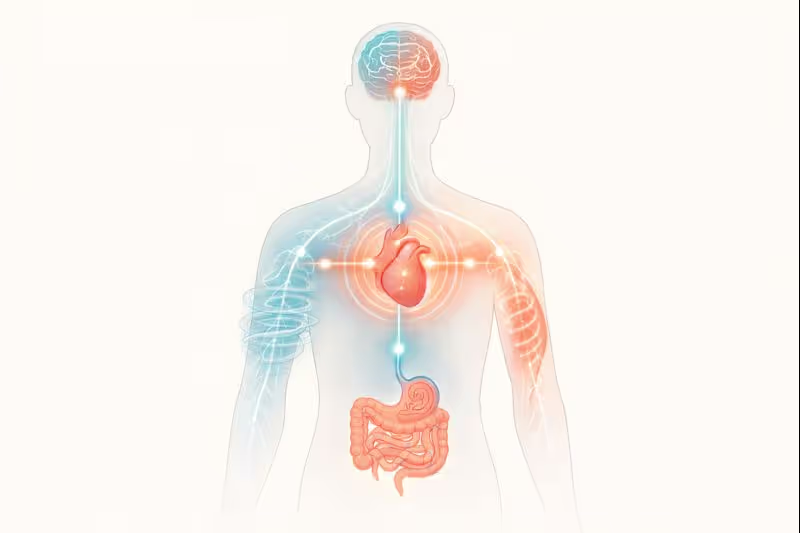
Here's what's crucial to understand: the physical sensations you experience are genuinely real. Your racing heart, that tightness in your chest, the tingling in your hands — these aren't imaginary. What happens is that your brain misinterprets ordinary bodily functions as danger signals. A muscle twitch becomes potential neurological disease. Fatigue becomes suspected cancer. Dizziness becomes an impending stroke.
The physical sensations are real — it's the interpretation that becomes problematic. Understanding this distinction is the first step toward freedom.
— Dr. David Barlow, Professor of Psychology, Boston University
Recognizing the Signs
Physical Manifestations
When your mind perceives medical threat, your body responds accordingly:
- Cardiovascular: Racing pulse, palpitations, chest tightness
- Neurological: Dizziness, tingling, numbness in extremities
- Muscular: Tension (especially neck, shoulders, jaw), unexplained aches
- Digestive: Nausea, stomach pain, appetite changes
- General: Fatigue, headaches, sweating
The cruel irony? These stress responses create the very sensations that fuel further worry — a self-perpetuating cycle.
Behavioral Patterns
Beyond physical experiences, certain behaviors signal this condition:
- Repeatedly checking your body for abnormalities
- Seeking reassurance from doctors, family, or the internet
- Spending hours researching medical information online
- Visiting multiple physicians for the same concern
- Difficulty concentrating because worried thoughts intrude
- Avoiding activities that might reveal something wrong — or conversely, avoiding doctors entirely
| Severity | Characteristics | Life Impact |
| Mild | Occasional worry, responds to reassurance | Minimal disruption |
| Moderate | Frequent preoccupation, regular checking behaviors | Affects work and relationships |
| Severe | Constant fixation, reassurance ineffective | Major impairment |
What Creates This Pattern?
Psychological Roots
Intolerance of uncertainty stands at the core. Most people accept they can't know everything about their body's inner workings. Those with illness worry find this uncertainty unbearable — and seek reassurance to eliminate it, which paradoxically strengthens the need for more reassurance.
Catastrophic interpretation plays a major role. The worried mind doesn't consider likely explanations first; it leaps to worst-case scenarios and works backward.
Heightened body awareness means noticing sensations others filter out unconsciously. This isn't a flaw — it's simply how some nervous systems operate — but it provides more "data" for the worried mind to misinterpret.
Life Experiences
Certain experiences increase vulnerability:
- Childhood exposure to serious illness (your own or a family member's)
- Traumatic medical experiences — misdiagnosis, painful procedures, medical errors
- Losing someone unexpectedly to disease
The COVID-19 pandemic significantly increased these fears globally

Author: Allison Monro;
Source: ameliaearhartbook.net
Breaking the Cycle: Self-Help Strategies
Stop the Reassurance Loop
This feels counterintuitive, but seeking reassurance actually worsens the problem. Each time you Google a symptom, check your body, or ask someone "Do you think I'm okay?" — you're training your brain that the worry was legitimate and required action.
How to interrupt this pattern:
- Notice when you're seeking reassurance
- Delay acting on the urge — start with 15 minutes, gradually extend
- Practice sitting with uncertainty rather than eliminating it
- Drastically limit medical internet searches
Reframe Your Thoughts
When worry strikes, challenge it:
- "What's the most likely explanation for this sensation?"
- "How many times have I feared the worst and been wrong?"
- "Am I confusing what's possible with what's probable?"
| Worried Thought | Reality Check | Balanced Response |
| "This headache must be something serious" | Headaches are extremely common; serious causes are rare | "Likely tension or dehydration. I'll monitor and see a doctor if it persists for weeks." |
Author: Allison Monro;
Source: ameliaearhartbook.net
Reduce Body Monitoring
Constant self-scanning amplifies normal sensations. That muscle twitch you'd never notice while absorbed in a movie becomes alarming when you're actively searching for problems.
- Identify your checking behaviors
- Set reduction goals
- Remove unnecessary monitoring tools
- Redirect attention outward
Lifestyle Foundations
- Exercise regularly — metabolizes stress hormones naturally
- Protect sleep — worry intensifies dramatically with sleep debt
- Limit caffeine — it mimics the physical sensations you fear
- Eat consistently — blood sugar drops trigger similar feelings
- Reduce medical media consumption — constant health news feeds the fire
The goal isn't eliminating all concern — it's responding to bodily sensations with curiosity rather than catastrophe, living fully even when uncertainty exists.
— Dr. Ellen Hendriksen, Clinical Psychologist
Professional Treatment Options
Cognitive Behavioral Therapy (CBT)
CBT remains the gold-standard treatment, with research showing 60-80% of people experience significant improvement within 12-20 sessions. You'll learn to identify thought patterns maintaining your worry, challenge catastrophic interpretations, and gradually face fears through structured exposure.
Other Approaches
- Acceptance and Commitment Therapy (ACT) — emphasizes accepting uncomfortable thoughts while pursuing meaningful action
- Mindfulness-Based Cognitive Therapy — combines meditation practices with cognitive techniques
Exposure and Response Prevention — focuses on facing fears without engaging in compulsive checking or reassurance-seeking

Author: Allison Monro;
Source: ameliaearhartbook.net
Medication
While not first-line treatment, SSRIs or SNRIs can help when:
- Worry is severely debilitating
- Depression co-occurs
- Therapy alone provides insufficient relief
Medication typically takes 4-8 weeks to reach effectiveness and works best combined with therapy.
When to Seek Professional Help
Consider reaching out if:
- Your worries have persisted six months or longer
- Daily functioning is significantly impaired
- Self-help strategies haven't helped after consistent effort
- You're experiencing depression alongside medical fears
- You're avoiding necessary healthcare out of fear
- Panic attacks occur related to illness concerns
Frequently Asked Questions
Moving Forward
If this article resonates with you, please know: you're not "crazy," you're not weak, and you're not alone. Millions of people share this struggle. More importantly, effective help exists.
Recovery doesn't mean never having another worried thought about your body. It means those thoughts lose their power. It means living fully rather than constantly monitoring for disaster. It means freedom.
You deserve that freedom. And it's absolutely within reach.
This article provides general information and is not a substitute for professional medical or mental health advice. Please consult a qualified professional for personalized guidance.